 Pralhad Gupta
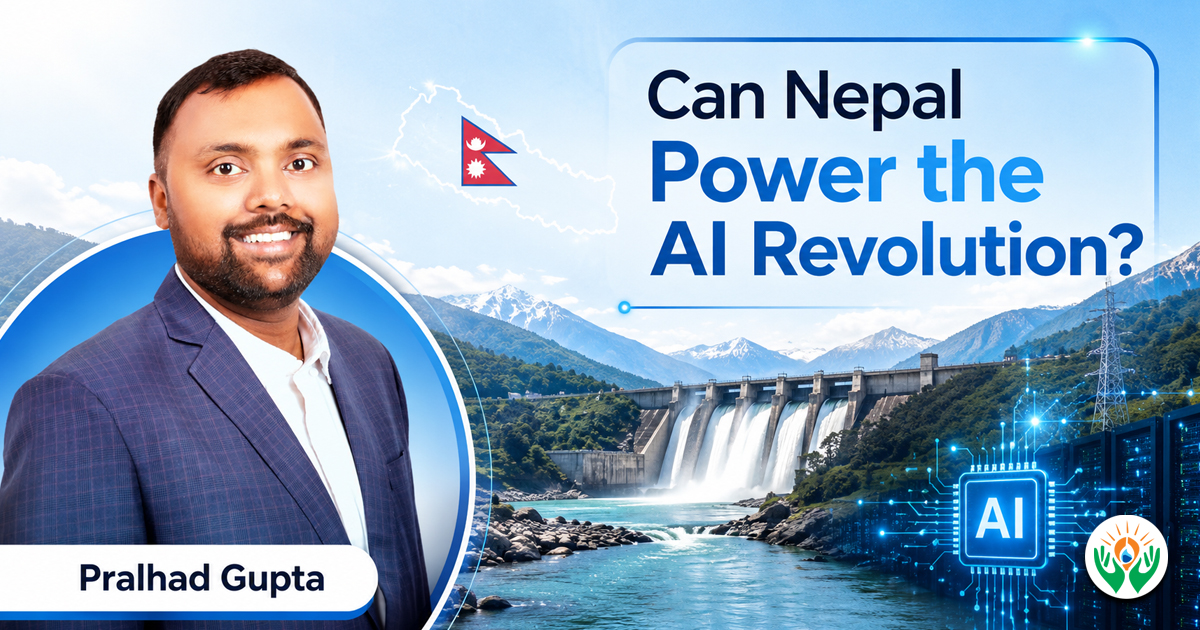
Nepal's newly appointed government is exploring ways to transition from selling raw electricity to selling computation, though historically the general trend has been exporting raw electricity to India during the season of surplus. Currently, data centres have emerged as a regular topic of discussion among policymakers. A Nepal-based company has announced plans to develop Tier IV hyperscale data centre facilities in Kathmandu and Birgunj, supported by technology partners including VVDN Technologies, Google Cloud, AMD, and Micron1. There were also rumours about a Meta investment earlier this year all over the internet, but they were denied by WorldLink, a Nepal-based telecommunications and internet company2. While current developments in the AI industry regularly come up in Nepal nowadays, it is important for all of us to think about whether Nepal can supply the energy, realise economic prosperity, and still manage the environmental impacts of becoming a hub of South Asia’s AI industry. To understand this further, we need to look at it through three lenses (energy, economy, environment), followed by viewing it from a geopolitical perspective.
Energy

By the end of FY 2024-25, Nepal's total installed capacity reached 3,591 MW, of which nearly 3,390 MW is hydroelectric, making it around 94% of total installed capacity3. In July 2025, the system recorded a peak of 2,901 MW, of which 2,214 MW was consumed nationally, while 687 MW was exported to India. While these numbers look promising, looking deeper into the seasonal data tells a different story. According to NEA's monthly data, peak generation falls from 2,901 MW in June-July to 1,438 MW in November-December, marking the year's highs and lows. Meanwhile, domestic peak demand stayed between 1,946 MW and 2,409 MW throughout the year. As a result, Nepal becomes a net importer through the dry months, with imports reaching 274 MW in December 2024-January 2025.
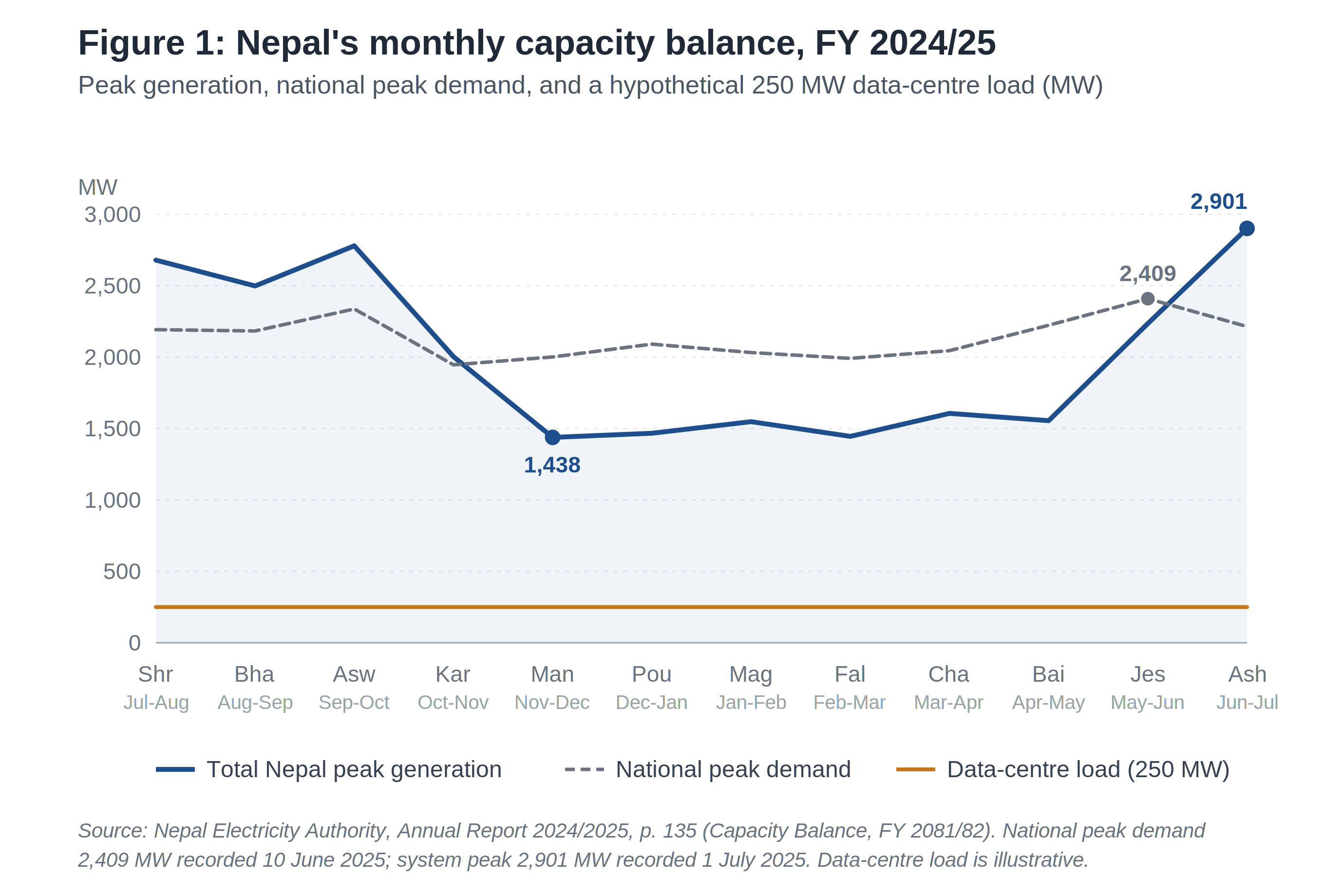 This becomes clearer from Figure 1 above. A data centre's electricity requirement remains flat, unlike Nepal's hydropower supply, which fluctuates quite a bit across seasons. Bichuten's first phase starts at just 240 kW and is planned to grow to 5 MW by 20301, which makes the immediate burden on the grid small. However, this industry is growing faster than ever, and scaling up usually happens quickly. AI training workloads can land in tens or hundreds of megawatts, and the point of concern is that they expect to get the same capacity twelve months a year, which goes against the way hydropower plants in Nepal operate.
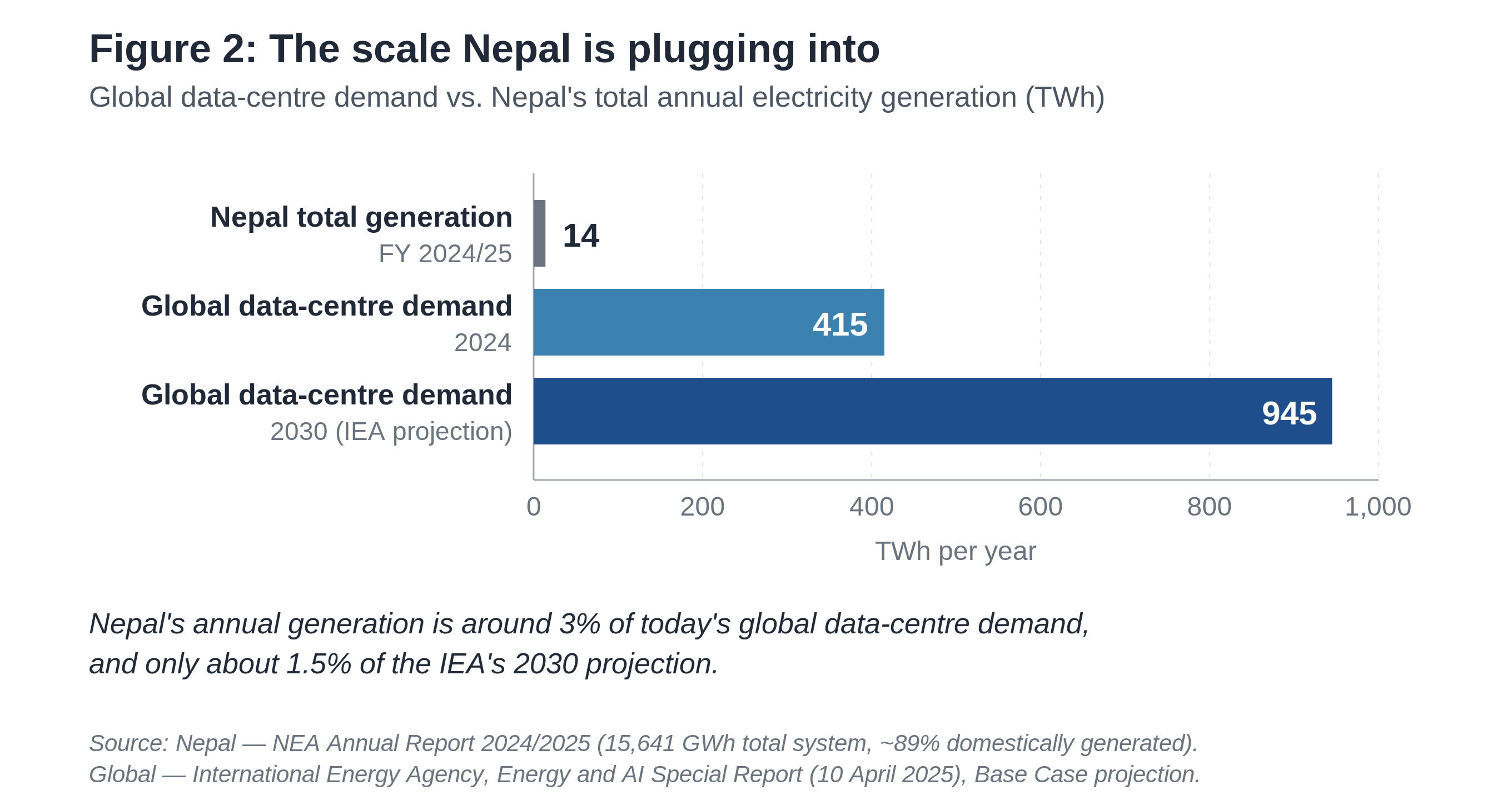 Figure 2 above shifts our discussion to a global perspective. According to the International Energy Agency (IEA), data centre electricity consumption is projected to roughly double from 415 TWh in 2024 to 945 TWh in 20304. Nepal's electricity demand is about 14 TWh3, which is barely 3% of today's global data centre demand, and nearly 1.5% of the 2030 projection. This comparison should not bother Nepal at all. Nepal doesn't necessarily have to capture a large share of the market to gain economic benefits. Even a small share could still bring global investment and create jobs for people in the country. However, to make this happen, Nepal needs electricity that is reliable and remains stable throughout the year, not just during the wet season. Run-of-river hydropower alone might not be sufficient to provide that steady supply.
That said, there are solutions and ways to make this happen. Reservoir storage, pumped hydro, batteries, dry-season solar, and hydrogen storage can help cover the seasonal gap—including using surplus hydropower to produce hydrogen that can be stored and used later when the electricity supply is low. Ironically, none of these is cheap, and none is fast. They are highly cost-intensive and represent sophisticated, complex approaches to energy storage. Nepal's Energy Development Roadmap 2081 sets a target of 28,500 MW of installed capacity by 20355. It will be interesting to see whether Nepal sequences data centres within that build-out or allows them to develop ahead of it. In my view, the right way is the first way: start by building more hydropower first.
"Hyperscalers do not care about seasons. Every megawatt promised to a data centre is a megawatt borrowed from a winter we will eventually have to repay."
Economy
There are all sorts of possibilities for moving up the value chain. Nepal currently sells electricity to Bangladesh under a five-year agreement at 6.4 US cents per kilowatt-hour, delivered through India's Dhalkebar-Muzaffarpur 400 kV corridor6. The same kilowatt-hour that runs through a server stack producing cloud or AI inference can sell for several times higher than that value. So, thinking about this makes a lot of sense from an economic perspective.
But a data-centre hub is not a single product. The realistic near-term opportunities for Nepal are narrower than the headlines suggest. Sovereign data hosting for government and banking, regional latency caching for northern India, and AI inference workloads can work in the next three to five years. Hyperscale AI training, at the top of the value chain, requires very large clusters, deep international fibre, mature regulation, and proximity to large customer bases. Nepal does not yet have these at scale.
The employment picture also deserves honesty. A modern 100-MW data centre directly employs only a few hundred people. The bigger prize is the ecosystem that the infrastructure could anchor over a decade: the software firms, AI startups, and cloud-native enterprises that grow alongside reliable digital infrastructure. Building such ecosystems has typically taken developed economies more than a decade. Nepal is unlikely to achieve this in five years.
Environment
The "green AI" pitch sounds interesting. Hydropower, no doubt, is a clean source of electricity production, and the added advantage of Nepal's cool weather also helps reduce the cost of cooling data centres. But there is one important issue we often ignore, and that is water use. A study from Lawrence Berkeley National Laboratory found that data centres in the US consumed about 66 billion litres of water for cooling in 2023, up from only 21.2 billion litres in 20147. This suggests how big an issue this can become in the future, as water demand for data centres will rise exponentially along with the AI industry and the booming digital market.
Considering Nepal's narrow valleys and limited groundwater, this could also become a serious concern for the country, and hosting large-scale data centres will not be easy here.
Another consideration is how ‘green’ this really is. If a data centre operates on hydropower in the rainy season but relies on imported electricity from, say, India, which is largely coal-based, in the dry season, then its clean energy claim becomes weaker. Climate-conscious clients in the EU and the US will notice this and ask about the source of electricity throughout the year. How clean a data centre really is depends on the source of electricity it uses.
Geopolitics
Nepal's location is very strategic, situated between China and India, the two competing giants of the digital economy in the data centre era. India already has certain rules that limit electricity imports linked to Chinese-backed companies8. A similar concern could appear in digital infrastructure, too. So, if Nepal hosts data centres, Indian customers will care about who owns them, who finances them, and which country controls the technology and servers.
At the same time, Nepal does have a real opportunity. It could serve as a digital hub for northern India, Bhutan, Bangladesh, and some parts of China. However, this requires a strong role by the Nepal government in building and maintaining strong cross-border power and data connections and setting clear rules for trade in digital services.
This also comes with a real risk. If Nepal leans more strongly toward one side than the other in digital politics, it may end up succeeding in one market while losing access to the other.
"In the data-centre era, Nepal sits between two competing visions of the digital world and must learn to host both without belonging to either."
Governance
Nepal does not have a dedicated regulatory framework for data centres, nor a fully comprehensive, modern data-protection law in force, nor a dedicated cybersecurity authority for large-scale digital infrastructure. There is a clear lack of a consistent framework specifically designed for hyperscale data centres, including tailored electricity tariff structures for firms that require 24/7 power and streamlined land-use and permitting processes for large-scale digital infrastructure.
To move forward, Nepal should focus on these three things: fair electricity pricing, a robust and standard system to classify data based on their sensitivity, and a clear way to screen foreign investment without discouraging it. None of this is technically difficult, but it does require a strong political focus before big data centre deals are signed.
The Way Forward
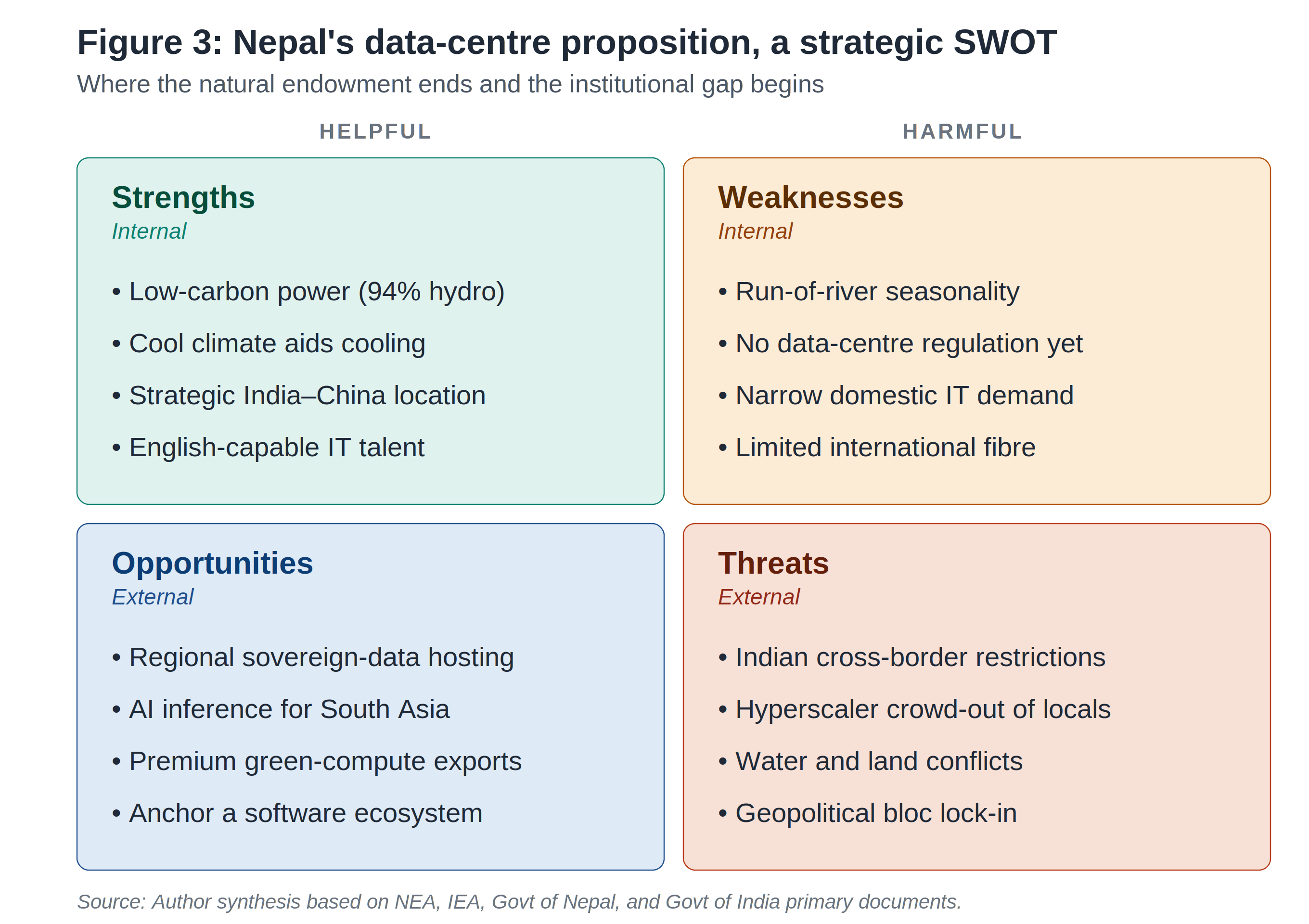 Figure 3 shows a clear picture of Nepal’s data centre opportunity in simple terms. Nepal’s strengths and opportunities include hydropower, its location, and a skilled workforce. The threats and weaknesses are associated with institutional gaps, seasonal power supply challenges, and reliance on foreign technology, investment, and external markets. Nepal’s natural resource base is strong, which puts the country on the radar of global AI leaders. However, whether its systems and policies are fully ready is still in question. This gap represents the main challenge for the next five years, which the government should address with full attention and focus.
"Done well, Nepal turns its rivers into one of South Asia's most valuable digital assets. Done in a hurry, it subsidises someone else's AI boom with our water, land, and sovereignty."
In my view, Nepal needs to focus on building the basics first: stable and reliable electricity that remains continuous throughout the year, which can be achieved, for example, by integrating energy storage systems; a strong data protection law; the development of more power and internet infrastructure; and a clear role in the regional digital economy.
The key questions we need to ask ourselves are: where, why, and how do we want to position our country in the regional digital economy? What is our position in South Asia? How can Nepal balance relations with China and India without over-dependence on either side? And what do we want from the global AI industry?
References
[1] The Himalayan Times. "Nepal to get first Tier IV hyperscale data center." May 2026.
[2] The Kathmandu Post. "WorldLink denies Meta investment claim as hype outpaces reality in Nepal's data centre rush." 9 May 2026.
[3] Nepal Electricity Authority. Annual Report 2024/2025 (Fiscal Year 2081/82). Published August 2025.
[4] International Energy Agency. Energy and AI, Special Report, 10 April 2025.
[5] Government of Nepal, Ministry of Energy, Water Resources and Irrigation. Energy Development Roadmap and Action Plan 2081, approved 31 December 2024.
[6] The Kathmandu Post. "Dhaka to import 20MW more from Nepal, taking total to 60MW." 27 November 2025.
[7] Shehabi, A., et al. (2024). 2024 United States Data Center Energy Usage Report. Lawrence Berkeley National Laboratory.
[8] Deccan Herald. "Centre to restrict import from neighbouring nations' power plants with Chinese link." 28 February 2021.
Mr. Gupta is a PhD candidate in Energy and Resources Engineering at Peking University, specializing in clean energy systems, hydrogen technologies, and electric mobility.
Mr. Gupta is a PhD Candidate in Energy and Resources Engineering at Peking University, where his research focuses on the techno-economic and life cycle analysis of green hydrogen and ammonia systems.