
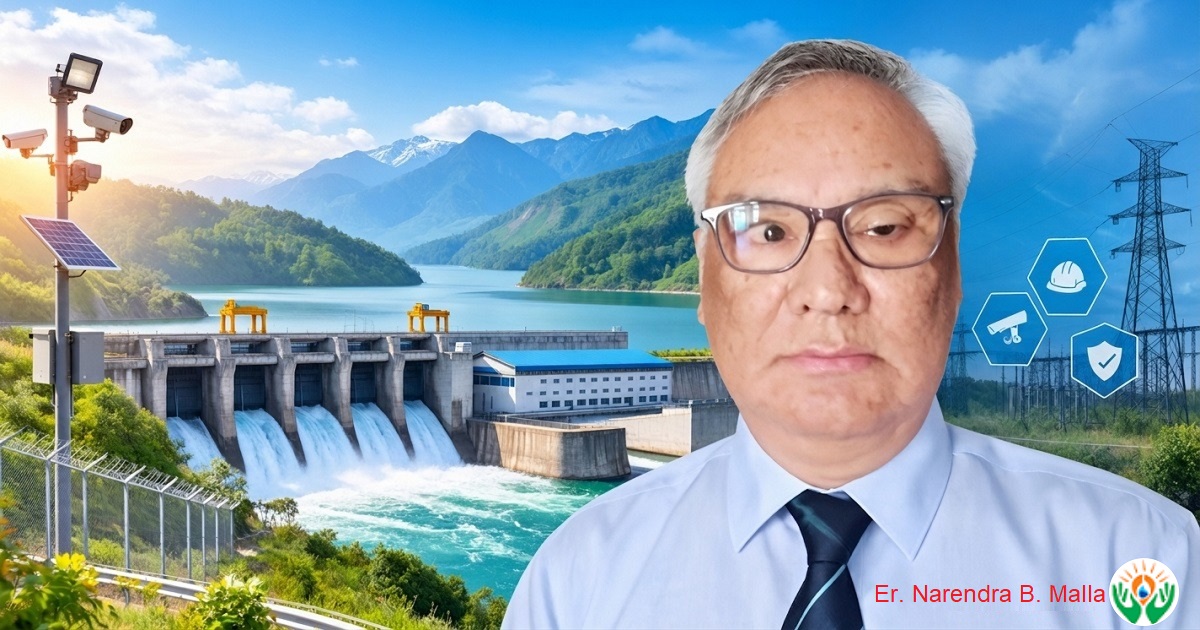
 Er. Narendra B. Malla
1. Abstract:
Nepal’s growing dependency on hydropower as the backbone of national energy security brings along an urgent need to address the safety and security of its hydroelectric power stations. Built within some of the most fragile geological formations and exposed to an increasingly erratic monsoon regime, these infrastructures face complex risks—ranging from natural hazards like landslides, floods, and earthquakes to human-induced threats such as poor maintenance, design deficiencies, institutional weaknesses, and in present context particularly, vandalism, sabotage, cyber-attack in oversight. Despite the establishment of regulatory bodies like the Department of Electricity Development and the Nepal Electricity Authority, institutional monitoring remains fragmented and largely non-functioning. Routine inspection and risk assessment are often conducted only after incidents occur. There is a clear absence of an integrated hydropower safety framework that enforces continuous surveillance, predictive modeling, and early warning mechanisms. To ensure the sustainability of Nepal’s power sector, safety monitoring must evolve from periodic formality to a proactive institutional culture. This calls for a national-level Hydropower Safety and Security Monitoring Authority with dedicated technical capacity, digital monitoring platforms, and inter-agency coordination to oversee dam health, flood as well as earthquake hazards slope failures, and emergency actions preparedness.

2. Introduction:
Nepal's hydroelectric sector is rapidly expanding, serving as a powerful engine for national development. This sector not only creates essential employment and attracts vital domestic and foreign investment, but it also improves electricity supply, builds crucial infrastructure in remote regions, and drives government revenue. The increasing momentum of hydro projects has boosted local construction capacity, fostered the growth of Nepali expertise in large-scale technology, and enabled the country to become a net exporter of power to neighboring India and Bangladesh. Furthermore, mechanisms like equity sharing with local communities and distributing royalties to local governments have proven effective in promoting poverty alleviation, protecting catchment areas, and executing preventive works against the adverse impacts of climate change.
Despite its immense potential and central role in economic growth, Nepal’s mountainous terrain subjects these critical power stations to pronounced and persistent hazards. The inherent geographical instability, including the country’s high susceptibility to severe earthquakes and the escalating damages from climate change-induced events like landslides and extreme floods—poses a grave threat to both lives and property. Protecting this infrastructure is paramount: the continuous, reliable supply of electricity is a fundamental precondition for industrial growth, competitive production, and modern life, where interruptions can have critical consequences, especially in essential services like hospitals. Therefore, the safety and security of hydroelectric facilities, encompassing the protection of valuable structures, personnel, downstream communities and system reliability, is a critical national concern.
So, this article emphasizes the urgent need for the institutionalization and standardization of procedures, rules, and regulations related to the safety and security of hydroelectric power stations in the current Nepali context.
3. Safety and Security Risks:
Hydroelectric plants in Nepal are crucial to national development but face a range of safety and security risks:
Natural Hazards: Precautions and careful procedures must be adopted during the site selection and design to tackle the hazards due to earthquakes, floods, landslides, and Glacial Lake Outburst Floods (GLOFs).
Operational Failures: The personnel handling the machine-like gates, instrumentation or other similar things must have the knowledge and the experience to operate them; otherwise, restrictions are to be made.
Fire: Fire is possible due to short circuits, negligence or any other reasons. In the powerhouse, there are precious equipment and cabling done everywhere with the equipment. Breaking out of fire in the powerhouse can cause big disasters.
There are buildings in the intake area that accommodate the equipment that is required to operate the gates. Fire hydrants, fire extinguishers, water sprinklers are to be installed in suitable locations. Design of the structures and their reinforcement is to be followed the criteria for Fire Resistance Class of 60 or 90 or similar are to be followed.
Human Factors: While handling the machines in operation or maintenance, the possibility of human errors can be entirely controlled by working according to the procedures mentioned in the manuals.
Security Threats: There always exists the possibility of security threats like vandalism, sabotage, theft, cyber intrusions to the facility.
Design Failures: The structures of a hydroelectric project are subjected to various loading conditions, including seismic loads, flood-induced loads, and loads associated with different modes of operation. The geological conditions affect the foundations and the entire stability of the structure. The design of hydroelectric structures is a complex process, and errors may occur due to uncertainties associated with loading conditions, material properties, site conditions, and other design parameters. Designs can be prepared in accordance with established Standards Engineering Practices to minimize errors and ensure structural safety and reliability.
4. Risk Management:
Effective risk management requires an integrated approach:
Robust Design and Construction Standards: Design and Construction come first to make the structure safe against the risks in all conditions. Analysis and design according to the Standard Engineering Practices is the primary condition for good construction that is safe against the identified risks.
Continuous Monitoring: The monitoring of the operation and the conditions of the structures like dam through the instrumentation will help to detect defects or malfunctioning and will recommend actions to prevent undesirable incidents.
Formal Dam-Safety: Any dam failure due to overtopping or too small spillway or any other reason can result big disaster with heavy losses of lives and property. In case of the dam breach, there is a chance that the entire stored water could be discharged with high flow-velocities.
Emergency Action Plans (EAPs): Action plans are always to keep ready for relief to the people in emergency hours caused by floods, incessant big rainfall, landslides, earthquakes or similar cases.
Escape Ways: The facility must have Escape Ways and Safe Gathering Places for the personnel working in the station in panic situations caused by earthquakes, fire breakouts or overflowing or similar incidents.
Community Engagement: Community participation may be beneficial and effective in rescue operations and safety and security monitoring mechanisms for the facility. Coordination Committees must be made with the representatives of the developer, local government and the disaster management agencies to conduct the relief works in the areas.
Downstream Warning Systems: The facility must install the Siren System for pre-warning the local communities before opening the spillway gates or fire breakout or floods or any similar type of events to prevent or reduce the losses of human lives and property. Recently, the release of high flood water by opening the spillway gates in the Kulekhani Dam had swept away and caused big losses on the shops and houses built on the downstream of the river.
Physical Security Measures: In Nepal’s present context, the surveillance with modern technology using video cameras and sponsors, regular patrolling, barbed wires, lightning, control-pass system for plant visitors must be carried out by deputing the security unit for the protection of the facility against vandalism, sabotage, theft and terror.
Cybersecurity: Against the Cyber-attacks, a team of experts with the required skill like relevant knowledge and experience in tracing and disabling the computer threats must be deputed in the facility.
Institutional Clarity: It follows the acts, rules and laws made by the Government of Nepal relating to the operation, monitoring and others effective to the hydroelectric power stations.
Capacity Building: To make familiar with the advancements in the technology and to train to tackle the challenging situation.
Routine Drills: Itis carried out in regular intervals of time to review and update the prevailing mechanism related to the safety and security conditions of the hydroelectric power stations.
5. Hazard Profile of Nepal:
• Seismic Risk: Nepal is in a highly seismically active region. Dams, penstocks, intake structures, powerhouse buildings and other valuable structures of the power station must be designed and assessed for earthquake loads; post-event inspections and instrumentation help detect damage. There must be the escape ways to safer places in such panic situations.
• Hydrological Extremes: Nepal has monsoon type of climate, in which more than 70 percent of the total annual precipitation falls only in three months that induces massive floods. Monsoon floods, flash floods, and sediment-laden flows threaten intake structures, spillways and downstream stability. In the present context, they are more critical since the impacts of climate change make them more intense and hazardous.
• Glacial Lake Outburst Floods (GLOFs): Himalayan glacial dynamics can produce sudden large flows that exceed design assumptions for upstream catchments. Since the process of melting the snow on the mountains has become faster, the possibilities of outburst of the lakes in the Himalayas have increased. The high flow will erode and take away the structures on its way and will leave the deposits of debris and moraine in the riverbanks.
• Landslides and Debris Flows: Slope failures during heavy rain or seismic shaking can obstruct waterways, damage access roads, or adversely affect dam abutments.
• Operational Risks: Mechanical failures (turbines, gates), human error, aging equipment, and insufficient maintenance can cause incidents. The regular maintenance of the machines is must procedure in the powerhouses. The spillway gates must be checked and maintained every year prior to the monsoon.
• Security Threats: Physical sabotage, theft of equipment and copper wiring, and cyber-attacks against control systems (SCADA/ICS) threaten operations and safety. A special security unit must be deputed in the power station with the responsibility of providing security for the facility, lives and surroundings.
6. Major Safety Concerns in Hydropower Stations:
1. Structural Safety:
The safety of the major structures in the hydroelectric power station is very important for the continuous operation of power generation. The water retained in a reservoir depends primarily on the stability of the dam. Without adequate stability, safe water storage would not be possible. Therefore, proper foundation selection, sound structural design, and quality construction of the dam play crucial roles in ensuring its overall stability.
In monsoon, there could be big floods that need to be released safely, for which the spillways of adequate capacities are needed. In the past, big disasters had occurred due to too small spillways, that caused the flood overtopping the dam. With the landslides of both the banks in the reservoir, the flow had overtopped the dam causing the heavy losses of lives and property downstream. The impacts of earthquakes on the dam, powerhouse and other structures can create big problems, for which the design and construction must consider the technique to make earthquake resistant.
2. Hydrological and Environmental Risks:
In Nepal, about 70 percent of the annual precipitation falls only in 3 months of the monsoon season creating floods of high intensities, that bring lot of sediments with. The floods in the rivers cause land-submergence, scouring, eroding, deposits of sand silt on the riverbanks. Most of the structures in the hydroelectric power station are located on areas near the rivers, which may be affected by the high floods. The selection of the site and the design, and construction of the structures must consider the flooding probabilities and their hazards.
3. Operational Safety:
The routine check-ups, repairs and maintenance work must be carried out at regular intervals of time to detect the problems with the machines and to keep them intact. The hydroelectric power station is a complex of various types of machines that are operated in synchronization with each other. Particularly in the powerhouse, the operational safety must be maintained to avoid the big accidents, that is possible only by handling the machines exactly according to the manuals given by the supplier.
4. Safety for Workers:
a. “The safety of the personnel at the workplace is a must and must be on the top of the priority in all circumstances.”
b. The safety of the personnel working at the various positions in the power station is the important one, for which the workers must be trained to enable them to work with the machines. The training must include the fundamentals of the machines, methods to work with, the possible hazards, and mitigation measures. The working spaces also matter in ensuring safety while working, that should have been taken into consideration as the operational requirements during design.
5. Maintenance Challenges:
The instrumentation in the various structures provides the necessary information about the physical conditions of the structure and the parameters like uplift pressures, deformation, and others that control their stability. Regular observations on the instruments and their evaluation are needed to know the conditions based on which the future action package can be brought.
7. Safety — Prevention, Monitoring and Response:
Maintaining safety in a hydroelectric power station, which comprises a complex array of machines and equipment, relies on effective mechanisms for prevention, monitoring, and timely response to potential hazards.
1. Design and Construction:
It is a preventive measure to provide the safety of the structure in the operative states. It is related with the early stages of site selection, design and construction of the structures. The hydroelectric power station structures are complex and must be designed and constructed according to accepted Engineering Practice Standards. This will help ensure that uncertainties and unexpected conditions do not affect the safety, reliability, or proper functioning of the power station. The following measures are therefore recommended:
• Adopt conservative design criteria for seismic, hydraulic and sediment loads; apply state-of-the-art geotechnical investigation and quality control during construction.
• Use redundancy where failure consequences are high (e.g., emergency gates, multiple monitoring channels).
2. Instrumentation and Monitoring:
It is the mechanism to study the physical conditions of the structures and the phenomena that is going under them. Based on the observation made on the instruments, necessary precautions and actions are to be recommendation to keep everything under control. Mainly the following procedures are recommended:
• Routine Instrumentation like piezometers, inclinometers, settlement markers, automated data logging, and remote telemetry enable early detection of anomalies like deflection or movements.
• Sediment Monitoring upstream and periodic bathymetric surveys are essential for reservoirs on high-silt rivers under a sediment lab. The study discloses the mechanism of abrasion of the water turbines in the powerhouse, based on which measures can be applied to reduce the action in necessary cases.
3. Maintenance and Competence:
The routine checkup, repairs and maintenance work will keep the equipment intact, prevent all of sudden break-ups, and save time and money. It belongs to the culture that the regular maintenance works are carried out irrespective of the functioning of the machines. In the hydroelectric power station, there are various types of equipment that need routine check-up and maintenance works for smooth operation of the system.
• Structured preventive maintenance programs for turbines, gates, and auxiliary systems.
• Continuous training and certification programs for operations staff; competency standards for dam safety engineers.
4. Emergency Preparedness:
In the past, situations have frequently arisen that required emergency measures. Therefore, it is essential to strengthen the capacity of the agencies concerned and personnel to respond effectively to such situations.
The coordination committees are to be built with the people from the developer, local government and disaster management authorities to launch quick rescue operations in emergency hours.
Every plant needs an Emergency Action Plan (EAP) and clearly defined trigger levels for actions (e.g., gate release, downstream warning).
Downstream warning systems (sirens, SMS alerts) integrated with local government evacuation plans.
Regular multi-agency drills, including local communities and emergency services.
8. Security for Power Stations:
In the present context, the protection of the facility from any undesirable acts is an urgent need, because the dependency on electricity is reasonably high and any interruption in the power supply will cause massive problems in the human life and ongoing systems of the country.
1. Physical Security:
Deputation of security unit with special skill for constant surveillance with the video cameras, good lighting in the camp, full fencing to prevent the encroachment in the facility, controlled visit with pass system, guard posts, detection of intrusion with sirens and well-connected roads for regular patrolling.
2. Cybersecurity:
Protection from the cyber-attacks on the computers of the control systems and prevention from SCADA vulnerabilities.
3. Natural and Human-Generated Threats:
a. Timely recognition of unstable areas or landslide zones and apply proper slope stabilization measures,
b. Make the structures earthquake resistant design according to Standard Practices,
c. Equip security unit with skills and necessary materials, conduct surveillance with video cameras and disable every undesirable act like vandalism, sabotage or terror activities.
4. Community-Related Security Issues:
The coordination committee comprising of the representatives of developers, local government and security should handle the issues related to people’s protests, local conflicts, social tensions.
9. Challenges in Ensuring Safety and Security:
• Inadequate Monitoring and Inspection:
Instrumentation, monitoring, evaluation, review and update provide the information about the conditions of the structure and the parameters governing the stability, based on which further actions should be recommended to strengthen or prevent undesirable developments. There should be preferably a unit in the power station that is responsible for carrying out these tasks. Regarding the sedimentation, a sediment lab can be made to look after collection of the samples, analysis of the samples and making reports, so that further actions can be planned. The National Safety Monitoring Authority issues the instructions, guidelines and working procedures in this sector.
• Lack of Dam Safety Regulations and Enforcement:
The safety of dams is very vital in the hydroelectrical power station, since dam failure due to any reason may lead to a big catastrophe in the region. The national safety monitoring authority prepares the guidelines for instrumentation, evaluation procedures, and rules and regulations for the mechanism to be followed for ensuring the safety of the dam and the other structures along with the safety of the personnel at the workplaces. Rules and regulations should be strictly followed to prevent accidents and improve overall safety. These may include inspection of spillway gates completed before the monsoon season, establishing safety standards and proper work procedures at all workplaces and follow up accordingly.
• Limited Emergency Preparedness and Response Plans:
Capacity building and management committees are very required to launch the rescue operations in the emergency hours. The coordination committees are to be formed with the developer, local government and disaster management experts so that quick actions can be initiated in the right way.
• Cybersecurity Awareness Gap:
The mode of operation for the various equipment is nowadays based on computer programs like SCADA, which, in case of not working properly, the manual operating may be the last option. This makes it very necessary to keep all computer programs free from cyber-attacks. The operation team should have the proper personnel skilled with the knowledge and experience in the field of disabling all types of threats and attacks on the computer systems.
• Budget and Manpower Constraints:
Budgeting is the pre-condition of realizing all these programs of monitoring, evaluation, capacity building for handling emergency situations and launching the rescue operations, making the required materials available in the need time, surveillance programs and others related of the security. The National Safety Monitoring Authority may instruct the government to make budgeting and programs related to safety and security of the hydroelectric power station.
10. Institutional and Legal Framework in Nepal:
The fast-growing sector of hydropower development is contributing to the country in many ways. The development of storage-based power plants is the need to balance the seasonal as well as diurnal fluctuations in the power supply. The sector experiences big losses due to floods in the Monsoon or due to the earthquakes and sometimes due to the protests of the local people. For maintaining the safety and security of the hydroelectric power plants, the need of the institutional set-up is strongly visible to define the framework for the procedures like monitoring, evaluation, surveillance, and others related, since the generation interruptions cause tremendous losses.
Hydroelectric Power Station Safety Act:
It defines the legal framework of the procedures including the instrumentation and the monitoring mechanism for maintaining the safety of the structures and the personnel working in the various stations in the power station.
National Hydroelectric Power Monitoring Authority:
The mechanism of monitoring, which must be followed to maintain the safety of the power station.
National Safety and Security Council: For independent inspection and investigation of the conditions of the plant structures,
operative conditions and incidents and prepare the report.
• Nepal Electricity Authority (NEA):
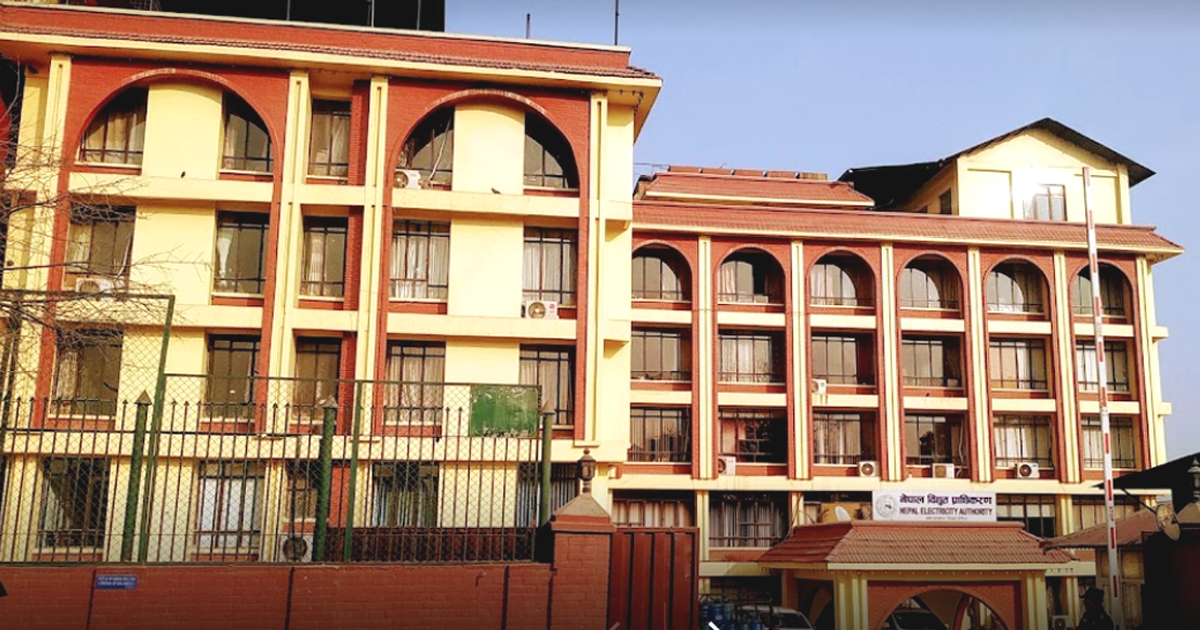
NEA, being the eldest organization in the electricity business is rich in the experiences in operating the power plants of the capacity ranging from few Kilowatts to several Hundred Megawatts, which if standardized, might be useful to many younger power plants in Nepal in the issues of maintaining the safety standards in the workplaces in the power station.
• Department of Electricity Development (DoED), and Local Governments:
The safety standards which must be maintained at the workplaces are to be prepared and instructed to apply in the workstations for the protection of the workers from accidents.
Similarly, they have to provide rules and regulations, which must be followed for the security of the power station, the people and the surroundings against vandalism, theft, sabotage.
• Coordination Committees: Built with the representatives of the developer, local government and disaster management agencies to coordinate, for enabling the quick operations particularly in emergency hours.
11. Institutional and Regulatory Aspects:
In Nepal’s present context, the issues related to the safety and security of the power station, lives, property and the surrounding should not be left as the merely responsibility and business of the developer, rather they need to be handled by the National Monitoring Authority with the safety Acts, Rules and regulations. Monitoring and regulatory mechanisms are very necessary for protection of the power stations with more organized mechanisms and regulatory measures. The authority will prepare the guidelines and procedures and instruct the power stations to follow them for the protection of the station, lives, property and the surroundings. Following are some of the issues, that the institutional set-up can handle to maintain the safety and security issues of the power stations in Nepal:
1. Instrumentation and Monitoring:
2. Regular Observations:
3. Review and update:
4. Recommendations:
5. Surveillance:
6. Capacity building:
7. Emergency Actions Prepare:
8. Safety Rules and Regulations at Workstations:
9. Safety in Fire:
10. Regular Repair and Maintenance works:
11. Early warning systems:
12. Coordination Committees:
13. Social issues:
14. EAP monitoring Mechanism:
15. Hydroelectric Power stations safety and Security Council:
Clear roles among owner/operators, national utility/regulator, local government, and emergency services are essential for coordination.
• Independent dam safety inspections and transparent reporting improve accountability and public trust.
• Licensing should require safety documentation: EAPs, monitoring plans, instrument records, and proof of staff competency.
12. Environmental and Social Considerations:
The impacts of global warming are visible in many parts of the country in the form of the floods occurring in unusual times with high intensities for short duration, causing the big slope failures, collapses of the roads and retaining structures, submergence of the areas and deposition of sands in flat lands. In many places, the houses, the shops and the agricultural farms were damaged causing heavy losses to the people.
The basic design must consider the impacts of the flooding and make safe against them particularly for the structures situated on the areas near by the river with necessary preventive measures like retaining walls. Recently, the newly built big substation was flooded, and a part of the foundation collapsed and was taken away by the flood. The overflooding of the powerhouse is much worse, because it causes the generation to shut down the generation for repair and cleaning the sand deposits. With heavy rainfall, landslides, slope failures, collapse of road portions are the most common in many parts of the country. The downstream impacts of the flow by operating the spillway gates to pass the floods belongs to the one of the main issues to be studied and handled in the design to prevent the big losses of the lives and the property. Such impacts on the safety of the lives and property due to flooding are to be handled in the design and construction.
Recently, the opening of the spillway gates in Kulekhani-1 dam caused big losses of the property of the people living on the downstream. Several residential houses, shops and road portions were damaged and partly taken away by the flow. Based on the observations made on the past, following can be suggested as preventive measures:
1.Early Warning System: The siren system has to be installed for early warnings to the people living in the area so that they can do something for the protection of the lives and property. Further extensions of the settlement in the risky areas have to be controlled to prevent any damage from the floods.
2. Coordination Committee: The coordination committees are to be made with the representatives of the developer, local government and disaster management agencies to make aware the local communities about possible dangers, for the prevention of disastrous developments effectively and launching the rescue operations in emergency hours.
3. Monitoring: The regular inspection and monitoring of the power station and the surrounding will update the conditions, crucial for the safety of the power station and recommend the necessary measures for prevention like the early warning system and rescue operation techniques.
4.Emergency Action Prepare: Since emergency situations have occurred very often in the various parts of the country, the need is obvious to organize under the coordination committee and equip them with the most essential materials.
5. Social Conflict: Any possible social conflict due to some undesirable impacts of the power station on the local communities’ lives and the property has to be handled with the participation of the coordination committee before worsening the situations.
6. National Monitoring Authority: In Nepal’s present context, the national monitoring authority is the need to develop the mechanism with the participation of the coordination committee for the identification and adopting the required measures to prevent the disastrous consequences.
13. Conclusion:
Ensuring the safety and security of hydroelectric power stations in Nepal is not merely the responsibility of developers; it is a national imperative. Hydropower assets represent strategic infrastructure—driving industrial growth, electrification, and economic transformation—while also involving significant public and private investment. As Nepal expands its hydropower portfolio, the risks associated with natural hazards, operational failures, and security threats grow in proportion.
A dedicated institutional architecture is essential to ensure systematic oversight, enforce compliance, and adopt modern risk-management standards. Establishing a comprehensive legal framework—supported by a Safety Act, an independent Safety and Security Regulatory Authority, and a National Safety Committee—will enable structured monitoring, standard-setting, and incident preparedness across all phases of hydropower development and operation.
In essence, hydropower safety in Nepal must transition from project-specific practices to a coordinated national system grounded in prevention, preparedness, and resilience. Protecting infrastructure, workers, communities, and natural resources is not only a technical obligation, but a cornerstone of national energy security and sustainable development.
13.1 Recommendations:
a). Policy and Institutional Framework:
Establish a National Hydropower Safety and Security Authority empowered to develop standards, monitor compliance, and enforce regulations.
Form a National Safety Committee to prepare guidelines, codes, and emergency protocols.
b). Technical and Operational Measures:
Ensure workplace safety through enforceable occupational health and safety regulations.
Introduce mandatory fire-resistant design standards and emergency escape facilities.
Require seismic-resistant engineering and functional alarm/communication systems for earthquakes.
Install early-warning sirens and deploy emergency-response teams during extreme flood events.
Conduct routine instrumentation monitoring and performance evaluations for structural integrity and equipment health.
Hold regular national and international forums to update practices and adopt emerging technologies.
Implement preventive field assessments to address risks related to landslides, slope instability, flooding, vandalism, and theft.
Provide specialized training and capacity-building programs for emergency response and rescue operations.
Establish coordination committees with developers, local governments, security agencies, and disaster-management authorities.
Enforce Systematic Maintenance Programs to prevent operational failures and prolong asset life.
13.2. Strategic Priority Actions:
• Mandatory periodic safety audits and risk assessments,
• Deployment of advanced monitoring systems (sensors, remote monitoring, GIS-based systems),
• Integration of security and emergency planning from inception to operation,
• Community-based early-warning and awareness programs, and
• Adoption and periodic testing of Dam Break Emergency Action Plans (EAPs).
13.3. Closing Statement:
Safety and security in hydropower development are continuous, evolving responsibilities—not one-time investments. In a country shaped by complex geology and increasing energy demands, Nepal must institutionalize robust safety systems, foster technological advancement, and build strong community partnerships. By embedding resilience, accountability, and preparedness into the hydropower sector, Nepal can safeguard lives, protect national assets, and guarantee sustainable and reliable energy for generations to come.
References:
1. Assessing the Safety & Security of Dams- C. Richard Donnelly.
2. Dam Safety Guidelines: ICOLD Bulletin: 59-1987.
3. Dam Safety Act-2021.Act no-41 of 2021, India.
4. Dam Safety Rules: US Army Corps Engineers-ER-1110-2-1156.
5. Dam Sector Security Guidelines: Homeland Security-2015.
6. Federal Guidelines of Dam Safety: US Dep. of Homeland Security-April 2004.