 Er. Saroj Koirala
For years, Power Purchase Agreements (PPAs) have been at the center of Nepal’s political noise. Heated debates, ministerial committees, and policy reversals have all circled around one question: should Nepal sign more PPAs?
This is the wrong question.

Nepal does not have a PPA problem. It has a market problem, one that we have consistently misdiagnosed as an engineering issue and, worse, politicized beyond reason.
The Origins of a Distortion
Nepal’s hydropower expansion was built on a simple premise: bankability requires certainty. Without a 100% offtake guarantee, no bank would finance projects. The state responded rationally, PPAs became the backbone of the sector.
Then came the load-shedding years. Scarcity turned into urgency. Policy focus shifted entirely to increasing generation. Licenses were handed out on a first-come, first-served basis. Quotas were expanded. The system rewarded speed, not system value.
A newly established and resource-constrained regulator, operating in a volatile political environment, did not intervene. It could not.
And so, the system drifted.
As a country bestowed with potential for hydropower development, we have long taken hydropower potential as our one shot to prosperity. However, resource endowment is not the same as feasibility. Take Kolar Gold Fields for example. In early 2000s, the gold fields were shut down, not because it ran out of gold, but because the gold would be too expensive by the time it reached the market. Hydropower might have the same story. Nepal’s hydropower can only deliver results to Nepalese economy if it’s strategized in a certain way.
The Structural Flaw: Seasonal Power in a Non-Seasonal Market
Today, a typical run-of-river (ROR) project in Nepal receives NPR 8.4/unit in the dry season and NPR 4.8/unit in the wet season in the base year, subject to escalation at the rate of around 3% for 8 years. These plants generate, on average, only about 64% of their installed capacity due to highly seasonal river flows.
But Nepal’s demand is not seasonal in the same way.
We do not need power that floods the grid during monsoon and disappears when demand stabilizes. We need energy profiles that deliver 80%+ generation reliability across the year. Instead, we have built a system optimized for rivers, not for markets.
Defenders of high-seasonality projects argue that designing for higher flow exceedance (i.e., more stable generation) is expensive. Structures must withstand monsoon peaks regardless, they say, so lower utilization is inevitable.
This argument is incomplete.
It ignores the most critical cost in the system: NEA is contractually obligated to pay for electricity it cannot use during the monsoon. The transmission lines are also underutilized for most portion of the year. Also, that “cheap” wet-season energy is not cheap if it is wasted. When you factor in the cost of surplus generation that cannot be absorbed or sold, the economics flip. More stable, higher-exceedance projects may have higher per-unit tariffs, but lower system-wide costs.
We have optimized for project-level tariffs, not system-level efficiency.
This is not to suggest that projects with high seasonality cannot be developed. However, the key point is that the Nepal Electricity Authority, as the steward of consumers’ electricity services, should not be burdened with such seasonality. Nepal’s power trade framework needs to be flexible enough to accommodate both national priorities and international commercial trade, but through distinct compartmentalized mechanisms.
The India Illusion
Another convenient narrative has taken hold: Nepal’s seasonal surplus will find lucrative markets in India because of “demand complementarity.”
This is, at best, a partial truth, and at worst, a dangerous assumption.
India’s peak demand occurs in April and May, when Nepal’s rivers are at their lowest. Our electricity is not available when India needs it most. Seasonal exports cannot substitute for firm capacity in a large, rapidly growing power system like India’s.
This is not to say there is no export potential. There is, and with Bangladesh in the map, there is definitely a cause to be optimistic. But it requires strategic alignment: project type, location, timing, and transmission and market access must be designed for the market.
Highly seasonal generation burdening a utility whose mandate is to serve the consumer, is not a pathway to export-led prosperity. It is a structural handicap.
A Pipeline Beyond Demand
Nepal’s peak demand is projected to reach around 7,000 MW by 2035, and perhaps 10,000 MW under accelerated economic growth.
Yet, PPAs have already been signed or committed for over 11,000 MW. That too without provision of adequate transmission infrastructure to evacuate the power.
This is not planning. This is inertia.
Every additional PPA signed today locks in future obligations—financial, operational, and political. It is effectively making long-term market decisions without a market framework.
We are not just overbuilding. We are overcommitting. We are stealing the right to make decision from our future selves, who, with passage of time should be wiser to take better decision.
The Reform We Refuse
The tragedy is not that Nepal lacks solutions. It is that it lacks the will to implement them.
Generation tariff structures should have been revisited years ago. Project selection should have been aligned with demand profiles. Regulatory intervention should have corrected course early.
None of this happened. Why? Because nearly every segment of Nepal’s middle class is now financially exposed to hydropower. Shares are widely held. Political sensitivity is high. Reform has losers—and in Nepal, those losers are investors who do not understand what they invested in. This is the country’s deepest conflict of interest: We all want returns, but no one wants regulation.
Engineering vs. Market: The Core Misunderstanding
Nepal continues to treat electricity as an engineering output problem, build more megawatts, and prosperity will follow.
This is fundamentally flawed.
Electricity is a market product. Its value depends on timing, reliability, and demand alignment. A megawatt generated at the wrong time is not just useless, it is a liability.
Right now, Nepal is supplying electricity that is optimized for neither domestic consumption nor export markets.
That is not a supply problem. It is a design failure.
The Committee Cycle
The newly formed ministerial committee on PPAs is unlikely to change this trajectory. Nepal does not need another committee providing a high-level report. It does not need another “Lal Aayog” to provide an excuse to bypass established legal procedure to make misguided decisions. It needs a process based on established laws and technically grounded market analysis, conducted by domain experts who are empowered, resourced, and accountable.
Committees do not solve structural problems. Evidence based decisions based on due process do. The regulatory body of electricity already has the rights and duties to do what the committee is expected to do. It only lacks the policy support of a strong government.
The Way Forward
A course correction is still possible, but the window is narrowing. We need to stop treating PPAs as political instruments. They are market contracts and must be governed as such. Align procurement with demand reality. NEA should buy electricity it can reliably sell domestically or through firm export arrangements. Prioritize system value over project volume. Accelerate legislative and regulatory reform. Allow power traders to operate for fully commercial trade of electricity. Improve climate of investment so the beneficiaries of electricity, domestic or international, can build a project and market it themselves. This will prevent government’s fund from being exposed to market volatility.
Most importantly, Nepal must accept a difficult truth: the longer we cling to a bad idea, the fewer viable options we will have to course correct. Let’s take storage hydropower plants, for example. Storage projects are absolutely necessary for Nepal to ensure energy security. But the question that haunts us is – what are you going to do with the energy from such projects in the monsoon. This is a price that Nepal has to pay for acting too late. A price for not steering the right way when the road started to turn.
Conclusion
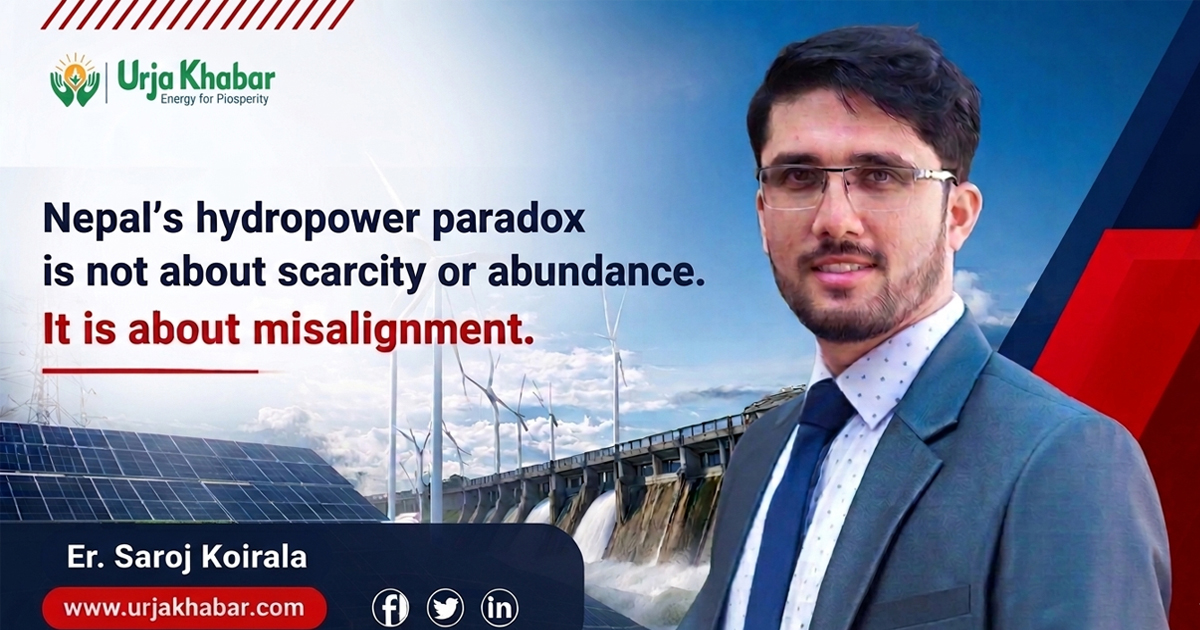
Nepal’s hydropower paradox is not about scarcity or abundance. It is about misalignment. We have built a pipeline of electricity that does not match our demand, does not align with export markets, and does not reflect system economics.
And we continue to debate PPAs as if they are the cause, rather than the symptom.
Until Nepal starts treating electricity as a market, not just as megawatts flowing through turbines, it will continue to overbuild power it cannot use, pay for energy it does not need, and postpone reforms it can no longer afford.
Koirala is an electrical engineer with a Bachelor of Laws (LL.B.) and a Master of Business Administration (MBA), currently working as a consultant in electricity policy, markets, and regulation. The views expressed are his own and do not necessarily reflect those of any institution with which he is affiliated.
Saroj Koirala is an electrical engineer with a Bachelor of Laws (LL.B.) and a Master of Business Administration (MBA), currently working as a consultant in electricity policy, markets, and regulation.