 Sampurna Ghimire
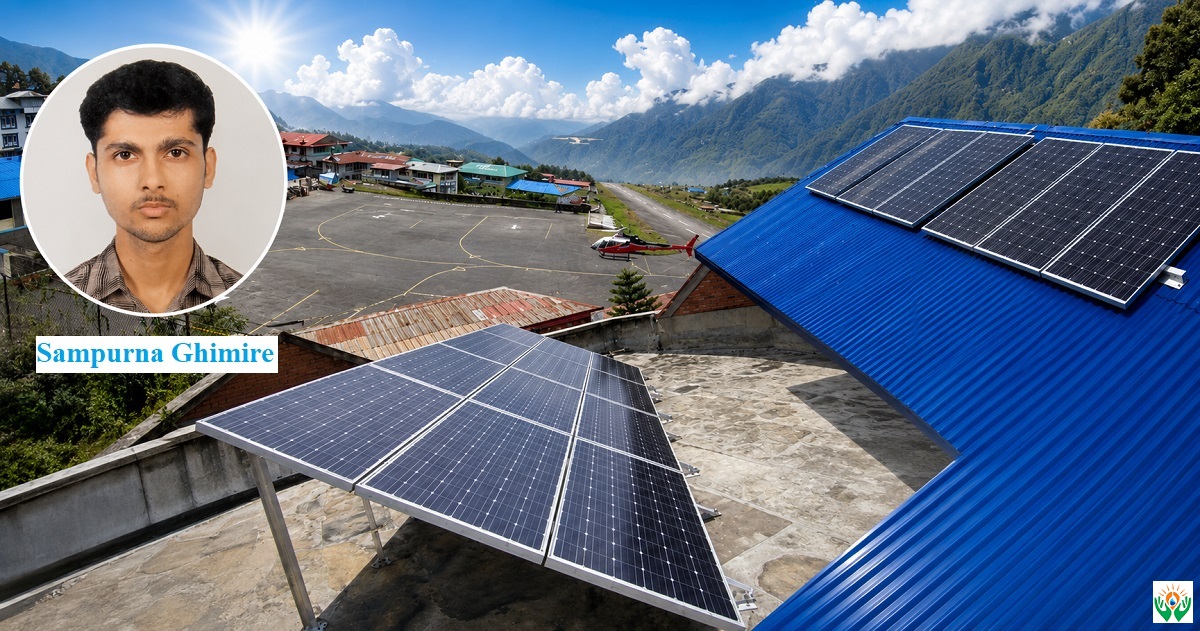
Nepal is a nation taking its first confident strides toward energy self-reliance. Yet policies like the reduction in net metering exchange rates threaten to clip the wings of this very promise. Solar is not a competitor to hydropower; it is a companion in Nepal's journey toward energy independence. Every unit exported by a rooftop solar system is a step toward a cleaner national grid. If short-sighted tariff cuts continue to erode the financial viability of solar investment, it risks discouraging the very innovation and private participation that Nepal needs to power its future.
Nepal gets nearly 300 sunny days a year and average solar insolation of 4.7 kWh/m²/day. Yet solar contributes barely over 0.1 percent of national electricity generation, even after eight years of endorsing 'supportive' policy documents. The gap between what Nepal's solar power can offer and what actually reaches the grid isn't a resource problem. It's an institutional, the Nepal Electricity Authority (NEA)'s own pricing and metering decisions.

The PPA Rate
In 2017, NEA's Grid Connected Alternative Electric Energy Development Procedure fixed a Power Purchase Agreement (PPA) rate of NPR 7.30 per unit for solar developers. That rate didn't last. NEA revised and downsized it to a competitive-bidding ceiling of NPR 5.94 per unit, a roughly 19 percent cut and made clear it would not pay above that ceiling regardless of a project's actual cost of generation.
Comparing it with what NEA pays for hydropower under the same 'take or pay' framework, the authority pays NPR 4.80 per unit in the rainy season and NPR 8.40–8.80 per unit in the dry winter months, when Nepal actually needs supplementary generation the most. Solar, which produces most reliably in exactly the dry, clear-sky winter months when hydropower output drops, is capped at a rate roughly a third lower than what dry-season hydropower earns.
Solar developers have pushed back publicly. As recently as June 2026, developers were still formally asking NEA to restore the old NPR 7.30 rate, arguing that anything below it makes new solar generation financially unviable to build. NEA's response so far has been the bidding ceiling, not a rate correction, effectively asking developers to compete each other's margins down rather than revising a rate that private industry says doesn't reflect real project economics.
Nepal published a formal net metering directive in 2018, meant to let rooftop and small commercial solar owners feed surplus power into the grid and draw credit against their bills. Then, in July 2022, NEA suspended net metering outright. Developers and solar associations organized petitions; over 350 signatures were collected within weeks demanding NEA reverse the decision.
NEA, built around a century of hydropower-first culture, treated the arrival of rooftop solar as a threat to be managed rather than a resource to be integrated and never invested in training its own distribution-center staff to process net metering applications competently. Solar developers reportedly ended up training NEA field staff themselves just to get systems connected.
Today, NEA's page states net metering exists and that customers "will receive credit on your bill." But the credit isn't the retail rate a consumer would otherwise pay for grid electricity. Exported solar power is bought back at the same NPR 5.94 per unit wholesale ceiling used for utility-scale bidding, while the same consumer still pays full retail tariffs for every unit they import. That's net billing dressed up as net metering.
What Does This Actually Means?
In principle, the fix isn't complicated. The solution may be to price solar PPAs closer at par to what dry-season hydropower earns, restore net metering credited at retail parity (as originally intended in 2018) rather than wholesale buy back, and treat interconnection processing as a core utility function.
The author is a Electrical Engineer at Lotus Energy Pvt. Ltd.
The author is a Electrical Engineer at Lotus Energy Pvt. Ltd.