 Urja Khabar
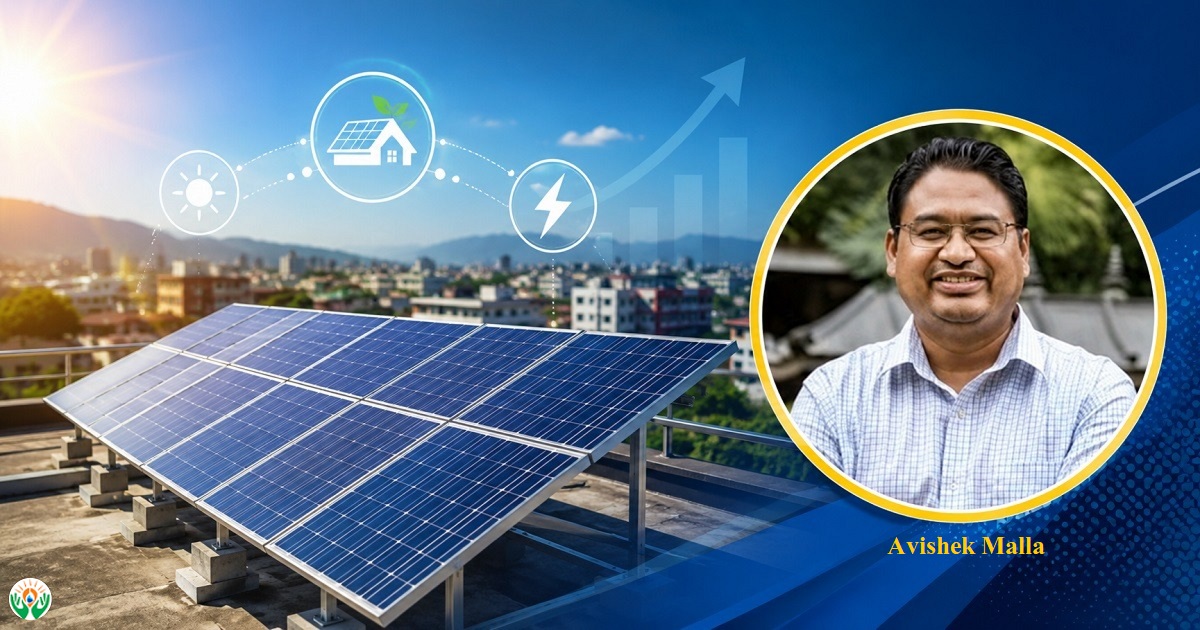
For years, solar power in Nepal served two primary purposes: providing backup electricity during chronic load-shedding and extending energy access to remote communities. The idea that rooftop solar could become a mainstream energy asset, capable of reducing electricity costs and attracting commercial financing, was almost unheard of.
This article reflects my experience in helping introduce a new business model that enabled companies to install rooftop solar systems with no upfront investment and repay them through the savings they generated. Looking back, success depended far less on the technology itself and far more on the issues like developing the ecosystem around it, aligning policy, finance, customer confidence, technical capability, and institutional support.

The journey ultimately revolved around five key interventions that transformed an ambitious idea into a scalable market model.
The Opportunity
Nine years ago, Nepal was emerging from a power crisis that had seen daily load-shedding stretch to as long as 18 hours. While electricity supply was improving, businesses remained highly conscious of energy reliability and cost.
At the same time, a different story was unfolding across Asia. Countries such as India and China were rapidly scaling solar deployment, driving down technology costs and demonstrating that solar energy could become a mainstream source of power. What had once been seen as a niche technology was increasingly being recognized as a viable commercial asset.
Nepal, however, was lagging behind. Commercial rooftop solar remained largely untapped, and very few businesses viewed solar as a reliable, grid-connected energy solution capable of reducing operating expenses and creating long-term value.
The challenge was never the technology.
Solar panels worked. The economics were increasingly compelling. Global supply chains were maturing rapidly. The real challenge was creating the conditions for the technology to succeed.
Having worked on Nepal's first grid-connected rooftop solar pilot projects in collaboration with the Nepal Electricity Authority (NEA) in 2011, I had witnessed both the enormous technical potential of solar PV rooftop, estimated at 3.5 gigawatt and the barriers that stood in the way of wider adoption. When net-metering regulations were introduced in 2018, an opportunity finally emerged to bridge the gap between policy ambition and commercial reality.
The Vision
The idea was straightforward:
Enable Nepali businesses to install rooftop solar with no upfront investment and use future electricity savings to pay for the system.
For businesses, it meant reducing electricity costs without diverting capital from their core operations. For banks, it meant financing an asset capable of generating predictable savings. For the energy sector, it offered a pathway to accelerate clean energy adoption through private investment rather than subsidies.
Simple as it sounded, the concept challenged almost every assumption that existed in the market.
Turning that vision into reality required much more effort than installing solar panels. It required building trust, mobilizing finance, strengthening supply chains, developing technical capacity, and aligning stakeholders across an ecosystem that was effectively learning together.
Building a Market from the Ground Up
The barriers were everywhere.
Utilities had limited experience integrating distributed solar generation into the grid. Commercial banks were familiar with financing small solar systems and battery-based backup solutions, but financing a power-generating asset capable of supplying electricity back to the grid was unfamiliar territory.
Supply chains were geared towards battery-based applications, reliable suppliers of grid-connected equipment were scarce, technical expertise was limited, and customer awareness was almost non-existent.
Looking back, success depended on addressing five interconnected challenges simultaneously.
1. Changing Perceptions and Building Trust
The first obstacle was changing perceptions.
Years of load-shedding had conditioned businesses to view solar as little more than a backup solution. Convincing a factory, hotel, or commercial building that it could operate primarily on solar energy without batteries was not easy.
I lost count of how many times I was asked:
"Can solar really run industrial motors?"
"How will it power my factory?"
"What happens on an overcast day?"
Even more surprising to many customers was the concept of net metering.
Many business owners had never imagined electricity flowing in both directions. Some genuinely worried that exporting power back to the grid might damage their meters or result in penalties from the utility.
The notion that a rooftop could function as a mini power plant, generating electricity for self-consumption while exporting excess energy to the grid, represented an entirely new way of thinking about energy.
Those early meetings became far more than sales presentations. Sitting across the table from entrepreneurs, finance managers, CFOs, and chartered accountants taught me an important lesson about decision-making.
Businesses were not interested in solar panels, inverter specifications, or performance ratios.
They wanted answers to a much simpler set of questions:
• What is my return on investment?
• What risks am I taking?
• What happens if the system underperforms?
• Can I trust the projected savings?
Solar was no longer being evaluated as an environmental initiative.
It was being evaluated as a business investment.
It took dozens of meetings, countless objections, and continuous refinement of our messaging to arrive at a proposition that resonated. Over time, we stopped talking like engineers and started speaking the language of CFOs, bankers, and business owners.
Instead of focusing on technology, we focused on business outcomes: lower electricity bills, tax advantages, predictable cash flows, and long-term returns.
Trust was equally important.
Customers needed confidence not only in the equipment, but also in the team, the company, and the business model itself. To address these concerns, we introduced performance guarantees and accountability mechanisms that assured customers the systems would deliver the projected energy output.
By assuming a significant share of the performance risk ourselves, we made it easier for businesses to take the first step.
As trust grew, so did confidence in the market.
2. Making Solar Financeable
Financing ultimately became the cornerstone of the model.
Our proposition was simple: customers would not make any upfront investment. Instead, the savings generated from lower electricity bills would be used to repay the financing over time.
While straightforward in theory, implementing this model required convincing banks to think differently.
Many lenders had never financed grid-connected rooftop solar projects before. Financing based on future energy savings rather than traditional collateral sat outside established banking norms.
A significant challenge emerged when lending regulations allowed banks to finance only 80 percent of project costs. The remaining 20 percent had to come from the customer.
For a model built around zero upfront investment, this presented a major hurdle.
Rather than abandoning the idea, we worked closely with financial institutions to develop mechanisms that addressed lender concerns while preserving the customer proposition.
The process involved extensive financial modelling, risk assessments, and confidence-building discussions. Over time, we demonstrated that properly designed solar projects could generate predictable savings capable of supporting loan repayment.
What initially appeared to be a major obstacle ultimately became a turning point.
It helped establish rooftop solar as a legitimate and financeable asset class within Nepal's banking sector.
3. Building a Reliable Supply Chain
Finance is only as strong as the assets it supports.
At the time, Nepal's solar ecosystem remained heavily focused on battery-based systems. Access to proven grid-connected technologies was limited, and local experience with commercial rooftop projects was scarce.
Significant effort went into identifying reliable technology partners, evaluating equipment quality, developing standardized system designs, and balancing performance with affordability.
Every project mattered.
Every successful installation became proof that the model worked.
Every satisfied customer became an advocate for the next project.
In emerging markets, successful projects often do more to build confidence than any marketing campaign ever could.
4. Building Skills and Institutions
Technology alone does not create markets.
People and institutions do.
Developing local technical capabilities became a priority. Teams were trained in solar resource assessment, system design, energy modelling, performance simulations, and operations and maintenance practices.
At the same time, net-metering regulations were still new, and implementation processes often remained unclear. Utilities, regulators, financiers, and developers were all navigating unfamiliar territory.
We worked closely with stakeholders to clarify procedures, streamline approvals, and address operational bottlenecks.
Market growth depended not only on engineering excellence but also on institutional readiness.
The success of distributed solar would ultimately depend on how effectively the ecosystem could collaborate.
5. Creating Confidence Across the Ecosystem
Beyond project development, significant effort was devoted to educating commercial and industrial customers, engaging financial institutions, standardizing contracts, and building partnerships across the value chain.
The objective was larger than selling individual systems.
We were building confidence in an entirely new market.
We wanted financiers, regulators, businesses, and technology providers to view rooftop solar not as an experiment but as a reliable, investable sector capable of delivering long-term value.
Creating a Blueprint for Growth
Within a relatively short period, these efforts helped mobilize private capital and support the development of some of Nepal's earliest large-scale commercial rooftop solar portfolios.
More importantly, they demonstrated that rooftop solar could be financially viable, scalable, and attractive to private investors.
Today, financing structures that once seemed unconventional have become increasingly common. Commercial banks actively support rooftop solar investments, private-sector participation has expanded significantly, and distributed generation has become an increasingly important part of Nepal's clean energy transition.
Looking back, the achievement was never really about selling "free" solar power.
It was about building trust where none existed.
It was about translating policy into investment, technology into business value, and energy savings into financeable assets.
Most importantly, it was about aligning technology, finance, institutions, and market incentives around a shared vision.
What began as an ambitious idea evolved into a commercially proven model that helped unlock private investment, accelerate rooftop solar adoption, and contribute to the foundations of Nepal's modern distributed energy market.
Perhaps the most important lesson is this: energy transitions are rarely constrained by technology. More often, they are constrained by the ecosystem required to support adoption. Technology may create the opportunity, but it is the alignment of policy, finance, institutions, and market confidence that turns possibility into scale.
Mr. Malla is an Intervention Manager – Renewable Energy at ICIMOD. All views and experiences shared in this article are personal and do not represent the official position of any institution, employer, or organization.




.jpg)
.jpg)