
 Nirmala Lama
Introduction
On 4 and 5 June, we had the opportunity to attend the 4th Conference of the South Asia Women in the Power Sector Professional Network (WePOWER), held in Negombo, Sri Lanka. The conference brought together around 150 women professionals working in the energy sector from across South Asia. It was organized by WePOWER with the support of the World Bank and ESMAP.

While the event was structured as a professional gathering, it also reflected a much deeper regional reality. Behind the discussions, presentations, and networking, there was a clear and persistent message: the gender gap in STEM (Science, Technology, Engineering and Mathematics) education and careers in South Asia remains significant, particularly in engineering and the energy sector.
WePOWER is a regional initiative established in 2019 to address the low participation of women in STEM and energy-related fields. It was created with a clear understanding that the problem is not only about entry into engineering education, but about the entire journey from school to career.
The network works to promote STEM education for girls and young women, support their into entry and advancement in technical professions, and encourage institutional and policy reforms that enable gender equality. More importantly, it attempts to connect education with real employment opportunities in the energy sector, ensuring that women are not only encouraged to study STEM but also supported to build long-term careers within it.
A Visible Gap
One of the most striking observations from the conference was the extremely low number of participants with a civil engineering background. Among the approximately 150 delegates, only about 10 came from engineering disciplines. This simple observation was powerful, as it reflected a deeper structural issue that cannot be ignored.
Despite years of initiatives, scholarships, outreach programs, and policy discussions, the presence of women in engineering remains limited across South Asia. The issue is not confined to any single country; it is a regional pattern that reveals a fragile STEM pipeline, particularly at the transition from education to professional practice.
The challenge of increasing women’s participation in STEM cannot be solved at the university or workplace level alone. It begins much earlier, often at school level, where perceptions about subjects and careers are formed. Many girls decide whether STEM is “for them” long before they reach higher education. If they do not see STEM as accessible, relevant, or encouraged, they are less likely to pursue it later.
This is why early exposure is critical. STEM must be introduced in a way that is practical and engaging, through hands-on learning, experimentation, and problem-solving that connects theory with real-life situations. Equally important is the way STEM is taught. When subjects are linked to real-world challenges such as health systems, environmental protection, infrastructure development, and energy access, students are better able to see their relevance. This connection helps transform STEM from an abstract academic subject into a meaningful tool for solving real problems.
However, even when girls perform well academically, confidence and social expectations continue to influence their decisions. In many cases, the lack of encouragement, combined with deeply rooted stereotypes, discourages them from pursuing STEM careers. This makes the role of teachers, parents, and institutions extremely important in shaping equal expectations and support for both girls and boys.
An Inspiring Moment
During the conference, we met a young girl who shared her success story after receiving World Bank-supported training in her own language. Her presentation was supported by an empowered woman who translated her speech into English. What stood out most was not only her story, but her confidence. Speaking in front of more than 150 delegates, she expressed herself clearly and without hesitation. In that moment, empowerment was not an abstract concept; it was visible and real. It demonstrated what becomes possible when opportunity, support, and confidence come together.
The presence of role models remains one of the most powerful influences in shaping career aspirations. When young women see engineers, architects, scientists, and researchers actively working in technical fields, it challenges the perception that STEM is not for them. Equally important is mentorship, which helps translate aspiration into direction. Beyond individual support, it creates a sense of belonging in fields where women are still underrepresented. The storytelling session during the conference further reinforced this idea. Every individual carries a unique story, and when these stories are shared, they become a source of motivation for others. Storytelling is not only about expression; it is also a form of connection. It builds trust, encourages reflection, and strengthens professional networks. In many ways, it becomes a bridge between experience and inspiration.
Institutional Responsibility
Improving women’s participation in STEM requires more than access to education. It requires institutions to create environments where women can remain, grow, and lead. This includes safe and inclusive academic spaces, financial support such as scholarships, peer networks that reduce isolation, and academic support in challenging subjects. At the same time, it is essential to address the transition from education to employment by clearly linking STEM learning with real career pathways.
When women can see visible opportunities in engineering firms, research institutions, infrastructure projects, and technology sectors, including opportunities for leadership, their likelihood of entering and remaining in STEM increases significantly.
Regional Collaboration
The second day of the conference focused on strengthening collaboration among institutions across South Asia. Discussions centered on formalizing governance arrangements for the WePOWER Global Secretariat and aligning national priorities with regional objectives.
Alongside these discussions, technical workshops explored practical areas such as fundraising strategies, communication systems, human resource performance metrics, occupational health and safety in energy institutions, and engagement with international networks. These sessions highlighted the importance of strengthening institutional capacity alongside policy commitments.
Conclusion
The conference concluded with strong commitments from participating countries and organizations to deepen collaboration, expand opportunities for women in the energy sector, and strengthen regional knowledge-sharing mechanisms.
However, the most important lesson was broader than the conference itself. The gender gap in STEM is not a single-point issue; it is a systemic challenge that begins early and .extends from early education through higher education and into professional life. Addressing it requires sustained effort across the entire pipeline, from early education to leadership opportunities.
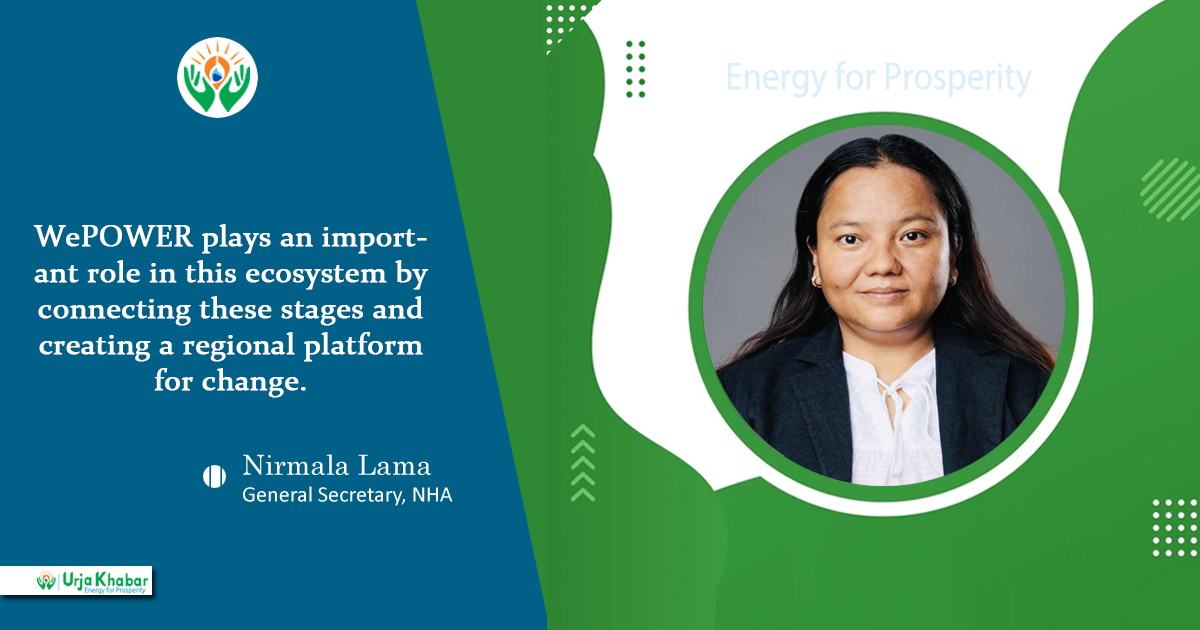
WePOWER plays an important role in this ecosystem by connecting these stages and creating a regional platform for change. The conference demonstrated both the progress that has been made and the distance that still needs to be covered. It also reaffirmed a shared commitment across South Asia to build a more inclusive and equitable future in STEM and the energy sector.
Mrs Lama is a General Secretary of Nepal Hydropower Association (NHA)