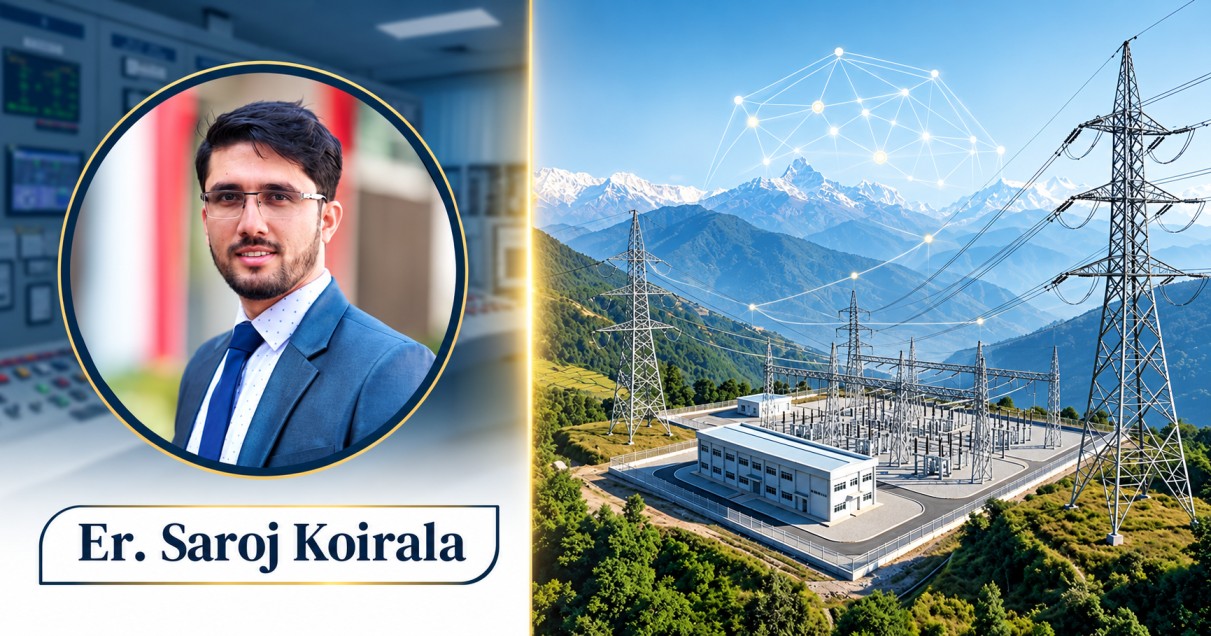
 Er. Saroj Koirala
In 2019, a dispute between APNRL, a generating company and PTC India Ltd., a licensed power trader reached the Central Electricity Regulatory Commission (CERC). APNRL sold electricity through PTC India Ltd., a licensed power trader, under back-to-back power purchase agreements with Tamil Nadu Generation and Distribution Corporation (TANGEDCO). When the distribution utility defaulted on its payments, the trader argued that it could not be expected to pay the generator until it had first been paid itself. This dispute raised a complicated question: who should carry the risk of default in a tripartite electricity transaction? Resolving it required interpreting of multiple interlinked contracts, power trading regulations, payment security mechanisms, and the regulatory framework governing India's electricity market. The dispute was heard by CERC, which ruled in 2020 that PTC had to pay APNRL under the PPA, even if TANGEDCO had not paid PTC first. In response to an appeal, the Appellate Tribunal for Electricity affirmed the CERC's decision, observing that a licensed power trader performs an important risk-allocation function in the electricity market and cannot rely on the absence of payment from the downstream buyer to escape obligations it assumed under its own agreement1.
Not every dispute is so efficiently resolved in India. Some disputes have taken years to resolve. In fact, expediting the resolution of electricity-sector disputes has become an important reform priority in India. But by creating a regulator, which is fundamentally a quasi-judicial institution, they have at least got the recipe right. Regulators are not simply government offices staffed by technical experts. They are specialized institutions created to regulate sectors where private investment, contractual complexity, and significant commercial risks intersect. For most regulated industries, their quasi-judicial role is not incidental; it is the most important one.

Nepal's dedicated feeder and trunk line dispute illustrates the cost of treating dispute resolution as an afterthought. When one of those disputes reached the Court, the esteemed Court observed, in substance, that a courtroom is not the place to verify electricity invoices or determine factual questions of billing2. Those are matters requiring technical examination, precisely what the regulator is for. The Court's role is to determine the legality of administrative actions, not to function as an accounting office for electricity disputes. The observation was correct. Yet by the time the ERC had been constituted, the issue had been too political for the regulator to resolve. Political systems have an unfortunate tendency to reduce complex disputes into stories of heroes and villains, and what should have remained a commercial disagreement instead became a way of virtue signaling and a test of political allegiance. That was damaging not only for the parties of the dispute but also for public confidence in public institutions. This case has exposed a deeper institutional weakness in Nepal. It revealed shortcomings not only in the laws governing Nepal's electricity sector but also in approaches to resolving commercial disputes.
The need for a sound regulatory response in dispute resolution only becomes significant as Nepal moves toward a multi-buyer electricity market. Until now, the Nepal Electricity Authority has effectively been the sole purchaser of electricity. The Commission's recently issued Open Access Directive symbols an important step toward a competitive market in which multiple buyers and sellers can transact power over shared transmission and distribution networks. For Nepal, this is a welcome reform as competition and consumer choice are not only enshrined in our constitutional policies and principles but are also essential to building an efficient electricity economy.
But a competitive market, however, is inherently more complex than a single-buyer system. Disputes over network access, transmission charges, congestion, scheduling, settlement, curtailment, and contractual obligations will become frequent. Many will involve investments worth billions of rupees, and many will inevitably involve public entities competing alongside private companies. If every disagreement is allowed to migrate into Cabinet discussions, parliamentary debate, or ordinary courts, commercial decisions will be shaped by political considerations rather than regulatory principles.
For that reason, Nepal must position the Electricity Regulatory Commission less as an administrative agency and more as a specialized quasi-judicial institution. India recognized this institutional requirement in the Electricity Act, 2003. While the regulator performs administrative and rule-making functions, the parliament also protected its adjudicatory independence. In India, Commissioners cannot simply be removed because their decisions inconvenience the government. Sections 90 and 117 of the Act have maintained strong safeguard measures for quasi-judicial officials such as members of central or state commissions or appellate tribunals by involving a judge of the Supreme Court in case if a motion forwarded for their removal. The principle is straightforward: an adjudicator deciding commercial disputes cannot remain independent if their vacation depends solely on the executive's satisfaction. Regulatory independence is therefore not a privilege for commissioners; it is an institutional guarantee for investors, consumers, and the government itself.
Ironically, Nepal's Electricity Regulatory Commission Act, 2017, largely understands this. The law equips the Commission with broad regulatory and quasi-judicial powers. The problem lies not in the statute but in its implementation, and the solution requires less action by the government, not more. To inspire confidence in a sector that will only grow more complex and increasingly depend on private investment, the Commission must be positioned as an independent and impartial institution that does not swing with the convenience of the executive. The autonomy guaranteed by law must also be respected in practice. Executive proactivity on matters within the regulator’s jurisdiction should be limited. At the same time, the Commission should be relieved of responsibilities that needlessly consume its regulatory capacity. Functions such as the pre-approval of public share issuances, among others, dilute the institutional focus needed to regulate and adjudicate an increasingly complex electricity market. But the recent ordinance dismissing members of the Commission, among other developments, illustrates how far we are from appreciating regulatory independence.
This should be a priority for the government because eventually, a strong regulator protects government by resolving commercial disputes before they become political crises. A weak regulator, eager to remain aligned with the government of the day, often produces the opposite outcome. When confidence in regulatory adjudication erodes, disputes inevitably migrate into politics where they destabilize governments, polarize public opinion, and hamper investment. A regulator that can resolve disputes promptly and fairly reduces the cost of doing business, improves investor confidence, and prevents undue politicization.
Nepal hopes to build prosperity through electricity. That ambition will require more than dams, transmission lines, and capital. It will require institutions capable of keeping commercial activities within the regulatory domain and outside politics. For that, it must be positioned as an independent quasi-judicial institution that happens to regulate electricity. The distinction may appear subtle, but for the future of Nepal’s electricity sector, it’s anything but.
(Saroj Koirala is a specialist in electricity regulation and policy.)
References:
[1]PTC India Ltd. v. Central Electricity Regulatory Commission & Ors., Appeal No. 168 of 2020 (App. Trib. Elec. May 8, 2025). https://aptel.gov.in/sites/default/files/202505/Judgment%20in%20Appeal%20No.%20168%20of%202020.pdf
[2] Panchakanya Plastic Industries Pvt. Ltd. v. Nepal Electricity Authority, Rupandehi District Court, Decision No. 911, Case No. 078-CI-0244, decided on 21 Poush 2079 (January 5, 2023).
Saroj Koirala is an electrical engineer with a Bachelor of Laws (LL.B.) and a Master of Business Administration (MBA), currently working as a consultant in electricity policy, markets, and regulation.