 Rahul Kumar Jha
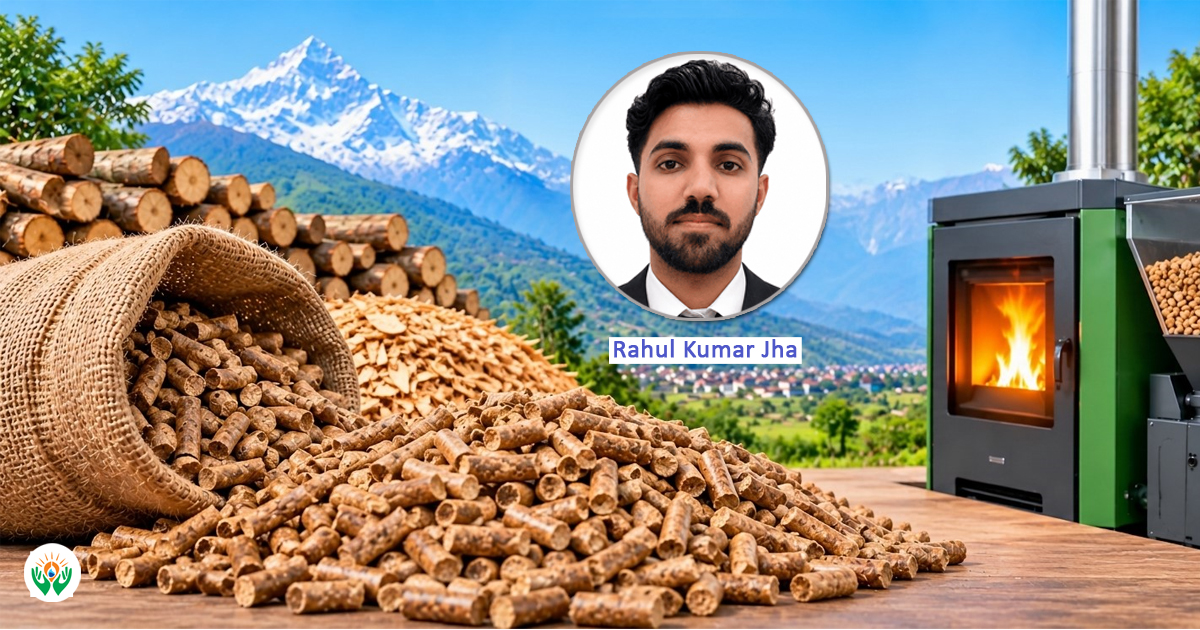
Nepal’s energy transition is often discussed through the expansion of hydropower, electric vehicles and electric cooking. These are undoubtedly important pillars of a cleaner energy future, but due to the delays in the development of necessary infrastructure, it is essential to diversify the technology. However, there is another energy resource that has received comparatively less attention despite being widely available across the country: Biomass.
Biomass remains an important source of energy in Nepal, particularly in the residential sector. For generations, Nepalese households have relied on firewood, agricultural residues and animal dung for cooking and heating. According to the Water and Energy Commission Secretariat (WECS), the residential sector accounted for around 60.75 percent of Nepal’s total energy consumption in 2024, with the large share associated mainly with biomass used for cooking and space heating. Nepal generates significant quantities of agricultural and forest residues that often have limited economic value or are poorly utilized. This creates an interesting paradox: Nepal has substantial biomass resources, but much of the country's biomass energy system remains traditional and inefficient.

One possible way to address this challenge is through the promotion of biomass pellets. Pellets are produced by processing and densifying suitable biomass residues such as sawdust, agricultural residues and other sustainably available biomass resources. Through densification, loose and bulky materials can be converted into a relatively standardized fuel that is easier to store, transport and use. With appropriate appliances, pellets can provide more controlled and efficient combustion than conventional use of loose biomass. The country's Biomass Energy Strategy has already recognized the importance of modernizing biomass energy use and increasing the utilization of agricultural, forest and other biomass residues. The strategy also emphasizes the development of modern biomass technologies and the participation of the private sector in biomass energy production and commercialization. This provides an important policy foundation for developing a modern biomass fuel market in Nepal.
Pellets are produced by processing and densifying suitable biomass residues such as sawdust, agricultural residues and other sustainably available biomass resources.
The real opportunity, however, lies beyond simply replacing firewood with another solid fuel. Biomass pellets could create an entire value chain in which agricultural and other biomass residues become an economic resource. Farmers and local suppliers could collect suitable residues, private companies could process them into pellets, distributors could establish local supply networks, and households, institutions and industries could use them as a standardized energy source. Such a system could generate economic opportunities while reducing the amount of biomass that is currently underutilized or openly burned.
However, the statement that Nepal has abundant biomass resources alone does not guarantee a successful pellet industry. The economics of biomass are highly dependent on location along with collection and transportation. The question is not simply matter with how much biomass exists, but with how much can be sustainably collected, where it is located, how much it costs to transport and whether it can be converted into pellets at a competitive price. Another, perhaps even more important challenge is demand. A consumer is unlikely to invest in a pellet stove if pellets are difficult to find or their prices are uncertain. At the same time, a private investor will hesitate to establish a large-scale pellet production facility if there is no reliable market for the fuel. This creates a circular problem: low demand discourages production while limited production keeps prices high and supply uncertain, and high prices and uncertain supply further discourage consumers.
The economics of biomass are highly dependent on location along with collection and transportation. The question is not simply matter with how much biomass exists, but with how much can be sustainably collected, where it is located, how much it costs to transport and whether it can be converted into pellets at a competitive price.
The important question is whether promoting a pellet stove and providing a subsidy without ensuring a reliable fuel supply is enough to solve this problem. If Nepal wants to develop biomass pellets as a modern energy fuel, should public support be provided? The answer could be yes, particularly during the early stage of market development, but the nature of the subsidy deserves careful consideration. Rather than focusing only on subsidizing the initial purchase of a pellet stove, Nepal could explore a consumption-linked approach in which part of the incentive is connected to the actual purchase and use of pellets over a defined initial period. Such an approach would shift the focus from simply counting the number of stoves distributed to measuring whether consumers are actually using the fuel. For example, an approved household or institution could receive an initial incentive for adopting an eligible pellet appliance, while subsequent support could be linked to verified purchases of pellets from registered suppliers. Such a system could create predictable demand for pellet producers, encourage sustained use by consumers and provide the government with valuable information about actual pellet consumption.
The objective of such a subsidy should not be to create permanent dependence on government support. Subsidies should be viewed as a tool for market creation. In the early stages, targeted support could help overcome the initial cost barrier and create sufficient demand for producers to invest. As production volumes increase, supply chains improve and competition develops, the level of subsidy could gradually decline. Eventually, the goal should be to establish a commercially viable pellet market in which government focuses primarily on quality standards, sustainability, consumer protection and market regulation rather than permanently subsidizing fuel consumption.
Another important consideration is where pellets should be used. Household cooking will certainly remain one potential market, particularly in areas where dependence on traditional biomass remains high and where electric cooking may not yet be the most practical or affordable option. However, limiting pellets only to household cooking would overlook a much larger opportunity. Institutional kitchens, hotels, restaurants, schools, hostels, hospitals, bakeries, agro-processing facilities and selected industrial thermal applications could all potentially become important users of pellet fuel. This broader market could be particularly valuable because institutional and industrial users may consume larger and more predictable quantities of fuel. Developing such demand could help pellet producers achieve economies of scale and reduce production costs. In the longer term, this could also make pellets more accessible to smaller consumers.
At the same time, different forms of energy like electricity, biogas and modern biomass should complement each other rather than compete directly. Where direct electrification is technically and economically feasible, electricity should increasingly become the preferred clean energy option. Biogas can continue to play an important role in households, farms and institutions with suitable organic feedstock. Pellets can serve applications where a solid fuel remains technically appropriate or where direct electrification is currently less practical. The objective should therefore be to select the most appropriate energy technology for each application rather than promoting a single fuel for all purposes. Nepal's energy transition will be stronger if it combines electrification with sustainable biomass, biogas and other renewable energy options according to local resources, technical requirements and economic conditions.
For Nepal, the next step should therefore be to move from isolated pellet projects toward the development of a complete pellet ecosystem. The government can provide policy support, standards, targeted incentives and market facilitation. Local governments can help identify biomass resources and their total demand, along with promoting institutional applications. The private sector can invest in pellet production, distribution, appliances and after-sales services. Farmers and local enterprises can participate in biomass collection and supply. Development partners and financial institutions can support market development mechanisms and investment in emerging technologies.
The question, therefore, is not simply whether biomass pellets can become Nepal's next clean energy fuel. The more important question is whether Nepal can create the policy, market and supply chain conditions required to make sustainable biomass pellets a viable part of the country's clean energy future. If the right conditions are created, materials that are currently treated as agricultural residues, waste or low-value biomass could become part of a modern energy economy, creating local employment, supporting cleaner cooking and industrial energy, reducing dependence on imported fuels and contributing to Nepal's broader energy transition.
Nepal does not necessarily need to abandon biomass. It needs to transform from traditional fuel-based economy into one with expanded access to modern energy resources.