Energy Update



Nepal's Electricity Exports Reach New Peak, Crossing Rs 29 billion in FY 2025/26
-
 Urja Khabar
- 23 July, 2026
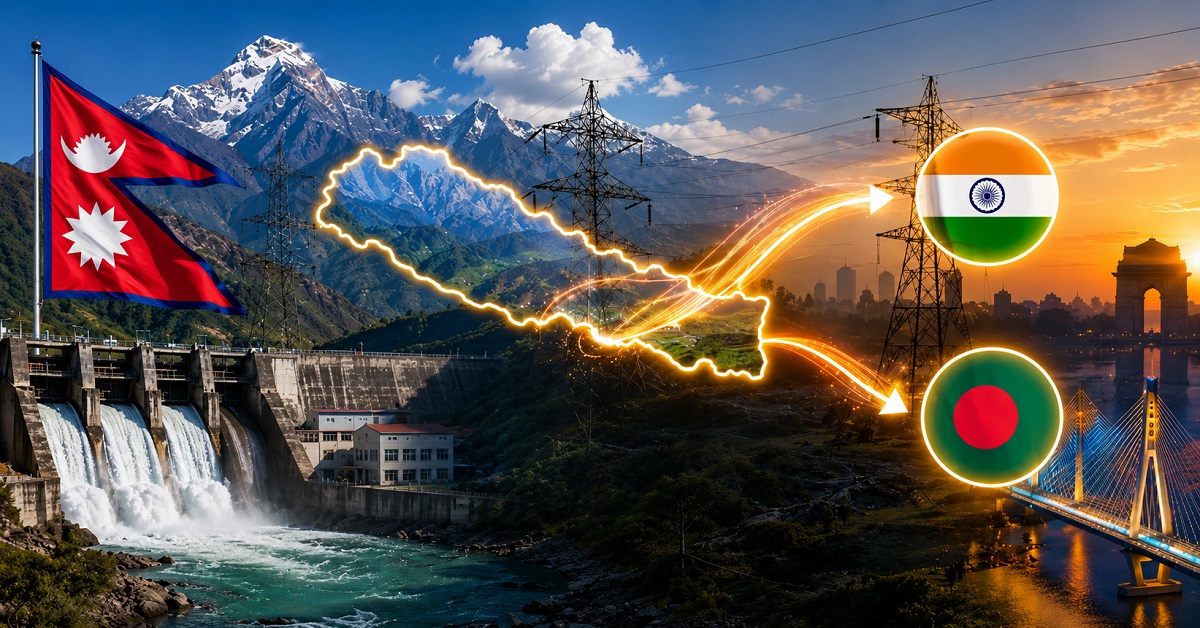
KATHMANDU; Nepal has achieved a historic milestone in its cross-border electricity trade, earning Rs 29.32 billion from power exports to India and Bangladesh during fiscal year 2025/26.
The record-breaking revenue represents the highest annual income Nepal has generated from electricity exports to date, underscoring the country’s rapidly strengthening position in the South Asian energy market.

According to statistics released by the Nepal Electricity Authority (NEA), export earnings surged by 67.96 percent compared to the previous fiscal year, when Nepal earned Rs 17.45 billion from cross-border electricity trade. The sharp increase reflects both a significant rise in export volume and Nepal’s expanding access to regional power markets.
Export Volume Rises by Nearly 63 Percent
In terms of electricity volume, Nepal exported 3.8774 billion units (kWh) in FY 2025/26, a remarkable 62.89 percent increase from 2.3829 billion units exported in FY 2024/25. This substantial growth highlights the country’s increasing surplus electricity production, driven primarily by the expansion of domestic hydropower generation.
The NEA sold electricity through multiple channels, including the Indian Energy Exchange (IEX)—via the Day-Ahead Market and Real-Time Market—through NTPC Vidyut Vyapar Nigam (NVVN), and under the trilateral power trade arrangement with Bangladesh. The average export price stood at Rs 7.56 per unit during the review period.
Imports Fall as Nepal Becomes More Self-Reliant
While export earnings reached an all-time high, Nepal’s electricity imports from India declined significantly in FY 2025/26. The imported volume fell by 31.57 percent to 1.1498 billion units, compared to the previous fiscal year.
Import expenditure also dropped by 18.29 percent, declining to Rs 10.55 billion. The reduction in imports reflects Nepal’s growing ability to meet domestic electricity demand through its own hydropower generation, particularly during periods of high river flow.
As a result, Nepal recorded a net gain of Rs 18.76 billion from cross-border electricity trade in FY 2025/26. This figure is more than four times higher than the Rs 4.53 billion net saving recorded in FY 2024/25, marking a dramatic improvement in the country’s energy trade balance.
From Import Dependency to Export Leadership
Nepal’s transformation in the regional electricity market has been swift and remarkable. It was only in October 2021 that India first approved the import of 39 MW of electricity from Nepal. In just four years, Nepal has expanded its export capacity to sell more than 1,000 MW of electricity to its southern neighbor during peak surplus periods.
The turning point came in fiscal year 2023/24, when Nepal became a net exporter of electricity for the first time, earning Rs 120 million from energy transactions with India. Since then, export volumes and revenues have grown exponentially, fueled by the commissioning of new hydropower projects and the expansion of cross-border transmission infrastructure.
What Are Driving Forces for the Growth?
Sector experts attribute the unprecedented increase in export earnings to several key factors:
- Rapid expansion of domestic hydropower production, creating larger seasonal surpluses.
- Improved cross-border transmission infrastructure, enabling higher export capacity to India and Bangladesh.
- Effective energy management by the NEA, optimizing sales through competitive electricity markets.
- Regional energy cooperation, including Nepal’s participation in India’s power exchanges and trilateral trade arrangements with Bangladesh.
The growth in exports also reflects Nepal’s strategic advantage as a hydropower-rich country. During the monsoon season, when river flows are abundant, Nepal generates more electricity than it can consume domestically, creating an opportunity to sell surplus power to neighboring countries.
A Stronger Position in South Asia’s Energy Landscape
The improved financial performance from cross-border energy trade signals Nepal’s emergence as a strong, self-reliant, and increasingly profitable electricity exporter in South Asia. For a landlocked country that once relied heavily on imported electricity to bridge domestic shortages, the shift represents a major economic and strategic achievement.
Beyond the immediate financial gains, rising electricity exports have broader implications for Nepal’s economy. Increased export revenue can help reduce pressure on foreign currency reserves, improve the financial health of the NEA, and create new opportunities for investment in hydropower and transmission infrastructure.
As Nepal continues to add new hydropower capacity and strengthen regional energy connectivity, the country is poised to play an even larger role in South Asia’s evolving power market. The record Rs 29.32 billion earned in FY 2025/26 may therefore be remembered not only as a historic financial achievement, but also as a defining moment in Nepal’s journey from an energy-deficient nation to a regional electricity exporter.
Conversation


More News





- Nepal's First Energy Based News Portal
-
Energy Information Center Pvt. Ltd.
Hemant Marg-11, Babar Mahal, Kathmandu
- Info. Dept. Reg. No. : 254/073/74
- Telephone : +977-1-5321303
- Email : [email protected]