Energy Update



FDI Pledges in Nepal’s Energy Sector Plunge to Just 20 Million
-
 Urja Khabar
- 18 August, 2026
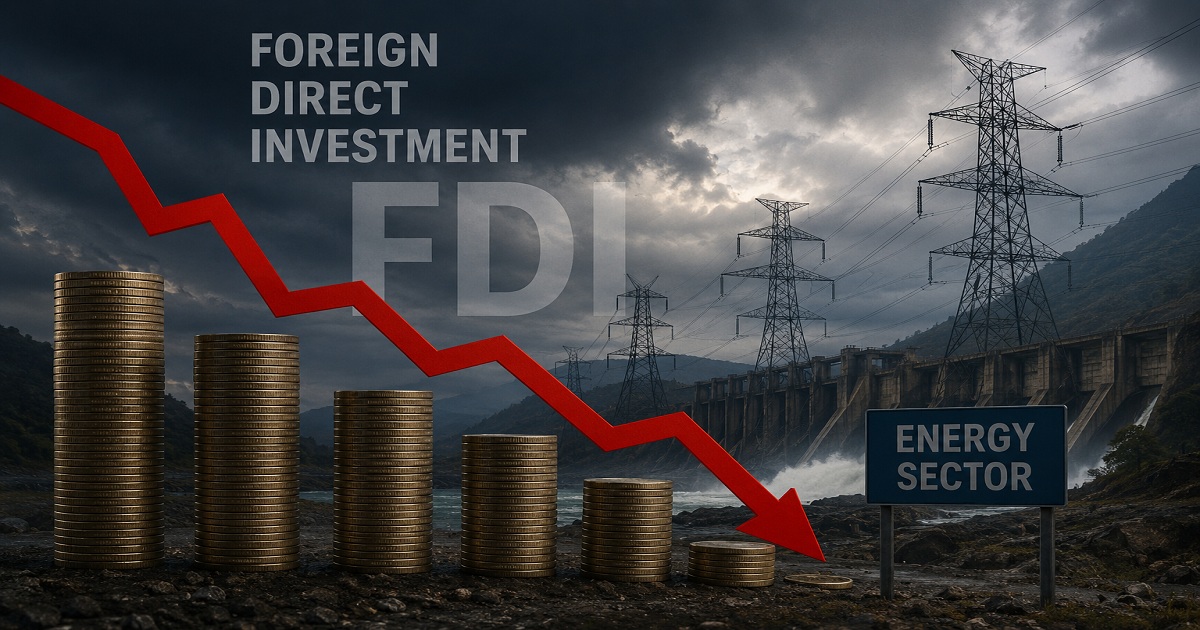
KATHMANDU; Foreign direct investment (FDI) interest in Nepal’s energy sector has plunged sharply, with the sector attracting commitments of just Rs 20 million in the first month of fiscal year 2026/27.
Data from the Department of Industry (DoI) show that foreign investors committed to investing in only one energy-sector project during the review period. In contrast, the information and communications technology (ICT) sector accounted for nearly 67 percent of the total approved projects.

The sharp decline in energy-sector commitments comes as overall foreign investment pledges in Nepal also witnessed a significant contraction. According to the DoI, total FDI commitments stood at Rs 3.77 billion in the first month of FY 2026/27, down 84.3 percent from Rs 24.10 billion recorded during the same period of the previous fiscal year.
Interestingly, the number of projects approved increased to 191 from 127 a year earlier. However, 188 of the approved projects were small-scale industries, indicating that the increase in project numbers has not translated into higher investment volumes.
DoI officials say foreign investors are increasingly opting for relatively small ventures requiring lower fixed capital, while large-scale sectors such as energy and infrastructure demand significantly higher upfront investment.
Energy sector losing its appeal to foreign investors
Nepal’s energy sector, particularly hydropower, has witnessed a steady decline in FDI commitments in recent years.
According to the DoI, Nepal’s hydropower sector attracted FDI commitments of Rs 86.81 billion in FY 2021/22, accounting for nearly one-third of the country’s total FDI commitments that year. However, investment commitments in the energy sector fell dramatically to Rs 7.16 billion in FY 2025/26.
The latest figure of just Rs 20 million in the first month of the current fiscal year further highlights the growing challenge of attracting foreign capital into Nepal’s energy and infrastructure projects.
Experts, however, believe Nepal continues to hold significant potential for foreign investment in tourism, agriculture, information technology, energy and manufacturing. They stress that unlocking this potential will require stable and predictable policies, faster government decision-making, improved infrastructure, stronger investment protection and timely implementation of approved projects.
Without addressing these structural challenges, they warn, Nepal may continue to struggle to convert its considerable investment potential—particularly in capital-intensive sectors such as energy—into actual foreign investment inflows.
Conversation


More News



- Nepal's First Energy Based News Portal
-
Energy Information Center Pvt. Ltd.
Hemant Marg-11, Babar Mahal, Kathmandu
- Info. Dept. Reg. No. : 254/073/74
- Telephone : +977-1-5321303
- Email : [email protected]