Energy Update


Why a Double-Curvature Concrete Arch Dam Best Fits Budhigandaki Project?
-
 Arun Rajauriya
- 1 October, 2026
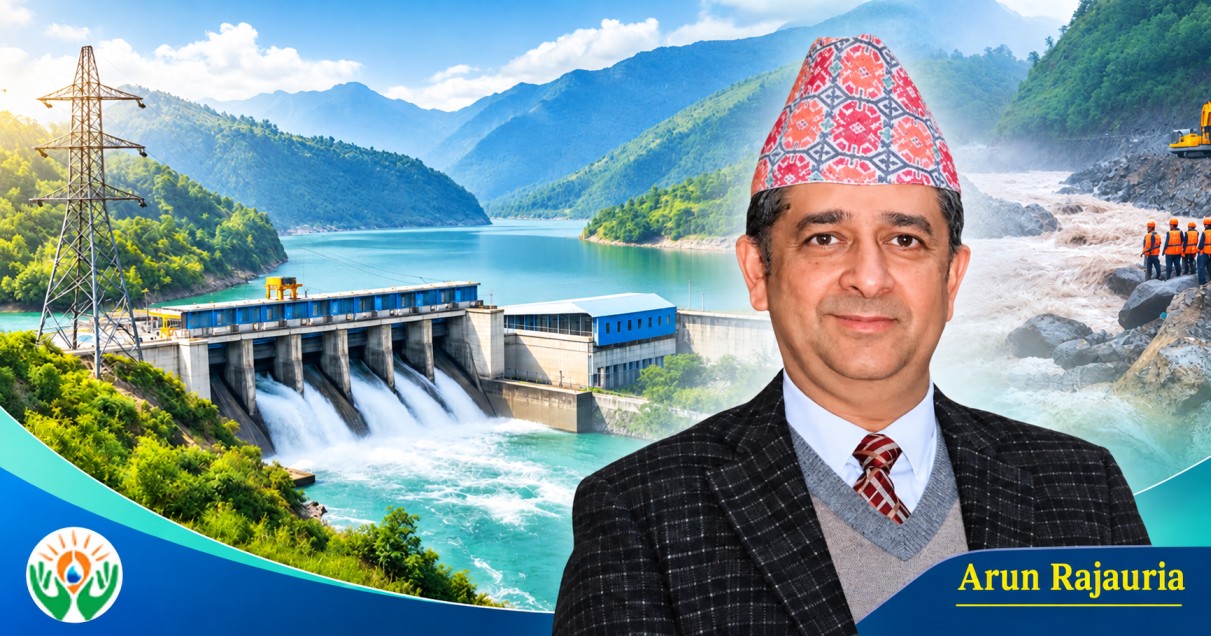
The 1,200 MW Budhigandaki Storage Hydropower Project is a strategic national infrastructure project. Its dam design must respond to Nepal’s unique Himalayan geology, seismic conditions, hydrology and industrial capabilities. The project studies and detailed engineering investigations have recommended a 263 meter high double-curvature concrete arch dam, a configuration particularly suited to the narrow Budhigandaki gorge and its strong rock abutments.
Unlike a conventional large embankment dam, a double-curvature arch dam transfers the major hydrostatic forces into the surrounding rock abutments, making efficient use of the naturally narrow and steep valley. Its thin structural section requires substantially less material volume than a massive rock-filled embankment, while offering advantages in deformation control, structural stiffness and long-term water tightness when founded on competent rock.

The choice also aligns with Nepal’s growing domestic industrial capacity. The country now has substantial cement and reinforcement-steel manufacturing capabilities, enabling a significant portion of the materials required for this concrete-intensive national project to be sourced domestically. The document estimates that the proposed dam will require around 6 million m³ of concrete, 2.5 million tons of cement and 0.5 million tons of reinforcement steel.
Beyond power generation, Budhigandaki is envisaged as a major seasonal energy-storage and grid-balancing project. Its large reservoir can also provide an important flood-mitigation function by regulating extreme inflows and moderating peak downstream flows, thereby helping reduce the impacts of floods on downstream communities, human lives and critical infrastructure.
In this context, the double-curvature arch dam is not merely a structural choice; it represents an integrated approach to energy security, flood-risk reduction, long-term infrastructure durability and national industrial development. The project document concludes that the geological suitability of the site, seismic and deformation considerations, material efficiency, domestic manufacturing capacity, durability and strategic objectives collectively support the adoption of the double-curvature arch-dam configuration for Budhigandaki.
For Budhigandaki Storage Hydropower project, the selection of a double-curvature concrete arch dam is considered technically and economically more suitable than a concrete-faced rock-fill dam (CFRD) given Nepal's unique geological, seismic, hydrological, and industrial conditions.
1. Suitability of Budhigandaki Gorge Geology for Arch Dam
The Budhigandaki dam site lies in a narrow and steep river gorge near Benighat with strong rock abutments, which are the conditions well suited to an arch dam.
In a double-curvature concrete arch dam, the hydrostatic load is transferred mainly into the canyon walls (abutments). Therefore, the stability and rock quality of the left and right abutments are more important than in a gravity dam or CFRD. The Budhigandaki site was selected because of its relatively narrow gorge and strong rock formations, which are considered suitable for arch action.
The project's feasibility studies and detailed engineering design (including six test adits/ tunnels, various drilling investigations, geotechnical analysis, dam-break analysis, physical modeling and numerical modeling, among others, have already recommended a 263 m high double-curvature concrete arch dam.
Why Geology Favors an Arch Dam
• A double-curvature arch dam transfers most of the hydrostatic load horizontally into the valley-side rock abutments.
• Narrow valleys with competent rock masses provide strong resistance against thrust forces.
• Budhigandaki site contains hard metamorphic and igneous Himalayan rock formations, which are suitable for anchoring an arch structure.
• Because the gorge is relatively narrow, an arch dam can require significantly less concrete than a comparable gravity dam and may be more economical than a large CFRD.
Limitation of a CFRD
A CFRD generally requires:
• A relatively broad embankment section
• Large quantities of suitable rock-fill materials
• Adequate valley geometry for economical construction
• Strict deformation tolerance control
In the steep Himalayan terrain of the Budhigandaki site:
• The valley width is comparatively narrow.
• High risk on foundation settlements and differential deformation
• Excessive rock-fill placement on steep slopes increases instability risk during earthquakes and monsoon.
Hence, the natural topography strongly supports an arch dam concept over CFRD.
2. Better Seismic Performance in Himalayan Conditions
Nepal lies in one of the world’s most seismically active regions due to the collision of the Indian and Eurasian tectonic plates.
Why Arch Dams Perform Better in Competent Rock
Modern double-curvature arch dams:
• Have high structural stiffness.
• Distribute loads efficiently to the rock abutments.
• Exhibit lower overall deformation.
• Can better resist dynamic earthquake loading when founded on sound, competent rock.
The Budhigandaki site is intended for a high-head storage reservoir with a capacity of around 4.5 BCM.
For such a very high dam:
• Excessive settlement in a CFRD can damage the upstream concrete face slab.
• Leakage risks may increase following strong seismic shaking.
• Long-term maintenance can become more difficult.
Research comparing an arch dam and CFRD alternatives for the Budhigandaki project found that the arch dam was more structurally efficient and economical under severe loading combinations.
3. Concrete Arch Dam Requires Much Less Construction Material
One of the major advantages of a double-curvature arch dam is its material efficiency.
A. Arch Dam
• Thin structural section.
• Small concrete volume.
• Lower excavation requirements.
• Reduced foundation treatment area.
B. CFRD
It requires:
• A massive rock-fill embankment
• Extensive quarrying operations
• Extensive hauling and placement work
• Substantial transition/filter zones.
For a 263 m high structure like proposed Budhigandaki:
• CFRD rock-fill volume would be enormous
• Construction duration would increase significantly
• Transportation and compaction challenges on Nepal’s mountainous terrain would rise sharply.
Therefore, a concrete arch dam is more practical for Nepal’s rugged Himalayan environment.
4. Growing Domestic Cement Industry Strengthening Nepal’s Concrete Dam Future
In earlier decades, Nepal lacked sufficient cement production, making large concrete dams difficult. The situation has changed significantly with more than 60 cement industries operating at present.
Nepal now has several major cement producers, such as:
A. Hongshi Shivam Cement Pvt. Ltd.
• Location: Sardi, Nawalparasi
• Capacity: 6,000 metric tons per day (MTPD) of cement/clinker, (equivalent to 2.3 million metric tons per annum)
B. Shivam Cements Limited
• Location: Hetauda, Makwanpur
• Capacity: 3,000 MTPD of cement
C. Sarbottam Cement Limited
• Location: Sunwal, Nawalparasi
• Capacity: 3,000 MTPD of cement (and around 3,000 MTPD of clinker)
D. Maruti Cements Limited (Maruti Group)
• Location: Mirchaiya, Siraha
• Capacity: 3,300 MTPD of clinker and 4,000 MTPD of cement
E. Ghorahi Cement Industry Pvt. Ltd.
• Location: Ghorahi, Dang
• Capacity: 2,200 MTPD of cement
F. Arghakhanchi Cement Limited
• Location: Mainahiya, Rupandehi
• Capacity: Around 1 million tons per annum (clinker and cement)
G. Palpa Cement Industries Ltd. (Tansen Cement)
• Location: Sunwal, Nawalparasi
• Capacity: 1,800 MTPD of clinker and 2,200 MTPD of cement
H. Jagdamba Cement Industries Pvt. Ltd.
• Location: Tilottama, Rupandehi
• Capacity: Around 3,000 MTPD capacity across integrated grinding units
I. Public / State-Owned Enterprises
• Udayapur Cement Industries Ltd. (UCIL): 800 MTPD
• Hetauda Cement Industries Ltd.: 800 to 1,000 MTPD
Nepal’s cement industry has expanded rapidly, supported by modern dry-process plants and clinker-production capacity.
Importance for Budhigandaki
A concrete arch dam:
• Utilizes domestic cement manufacturing capability
• Supports Nepalese industrial growth
• Reduces dependency on imported construction materials
• Generates significant domestic economic multiplier effects
Since the Budhigandaki Project has been planned largely with domestic financing participation, maximizing local industrial utilization is strategically important.
5. Nepal’s Reinforcement Steel Production and Fabrication Capacity
Nepal also possesses significant domestic steel reinforcement manufacturing and fabrication capability through industries, such as:
A. Jagdamba Steels Pvt. Ltd.
• Location: Simara, Bara
• Capacity: More than 2,500 metric tons per day (MTD) or up to 75,000 metric tons per month
• Products: TMT reinforcement bars, structural steel (beams, channels, angles), HR sheets, and galvanized wire. (It is also noted as one of the first manufacturers of structural steel products in Nepal).
B. Ambe Group (Ambe Steels Ltd. & Jay Ambe Steels Ltd.)
• Locations: Bhairahawa and Nepalgunj
• Capacity: 1,400 MTD combined capacity (Ambe Steels: 400 MTD and Jay Ambe Steels: 1,000 MTD)
• Products: High-strength TMT reinforcement bars, structural sections, and GI wires.
C. Laxmi Steels Pvt. Ltd.
• Location: Sunwal, Nawalparasi
• Capacity: 10,000 metric tons per month (approx. 182,500 MT annually)
• Products: TMT bars manufactured using German Thermex technology.
D. Bajrang Steel Industries
• Location: Duhabi, Sunsari
• Capacity: 500 metric tons per day
• Products: High-strength TMT bars, billets, and precision-engineered structural sections.
E. Premier Steel Pvt. Ltd.
• Location: Duhabi, Sunsari
• Capacity: 800 metric tonnes per day
• Products: TMT bars manufactured through automated processes.
F. Panchakanya Group (Panchakanya Steel)
• Location: Bhairahawa
• Capacity: 100,000 metric tons per annum
• Products: TMT steel bars and structural profiles.
G. Narayani Group (Narayani Steels, Narayani Strips, etc.)
• Location: Simara, Bara
• Capacity: The combined production capacity ranges between 150,000 and 582,000 metric tons annually (varies by subsidiary and product line like sheets and pipes).
• Products: Pipes, sheets, chequered plates, and TMT bars.
H. Hulas Steel Industries Limited
• Location: Simara, Bara
• Capacity: Variable high-capacity cold/hot rolling lines (25,000 plus metric tons per year across specific divisions)
• Products: CR/HR coils, tubular pipes, aluminum extrusion, and structural wire products.
I. Hama Iron & Steel Industries Pvt. Ltd.
• Location: Simara, Bara
• Capacity: Approx. 150 to 200 metric tons per day (depending on structural or rolling specifications)
• Products: TMT rebars and structural steel sections.
Although specialized hydromechanical equipment would still require international procurement, Nepal has now developed sufficient domestic capacity to supply a substantial portion of the civil-construction materials.
This strengthens the feasibility of a concrete-intensive arch dam structure.
6. Long-Term Durability and Reduced Leakage Risk
For a very large national storage project:
• Long-term water tightness is critical
• Reservoir-induced maintenance costs must remain low.
Potential Advantages of an Arch Dam
• Monolithic concrete structure
• Lower seepage potential
• Lower deformation
• Longer service life
• Lower maintenance requirements.
CFRD Concerns at Very High Dams
Globally, very high CFRDs have experienced several challenges like:
• Cracking of concrete face slab
• Settlement-related leakage
• Joint deformation issues
Because Budhigandaki is a national pride strategic storage project intended to operate for decades, long-term structural durability is extremely important.
7. Hydropower Optimization and Energy Security
Budhigandaki is not only a power-generation project; it is envisioned as Nepal’s:
• Seasonal energy storage backbone
• Dry-season power stabilizer
• Grid-balancing project
• Export-oriented strategic reservoir
• Flood-mitigation assets capable of moderating peak flows and protecting lives, communities and critical infrastructure downstream
A rigid concrete arch dam can provide several possible advantages, such as:
• Better operational reliability
• Better spillway integration
• Higher hydraulic efficiency for deep reservoirs
• Improved safety monitoring
Conclusion
The double-curvature concrete arch dam is considered superior to a CFRD for Budhigandaki mainly because:
1. The narrow Himalayan gorge and strong rock abutments are ideal for arch action.
2. Arch dams are structurally more efficient for very high dams like the proposed 263 m Budhigandaki structure.
3. Seismic performance and deformation control are better in competent rock conditions.
4. Concrete volume remains lower than the massive rock-fill required for a CFRD
5. Nepal has developed sufficient domestic cement and reinforcement steel manufacturing capability to support large-scale concrete infrastructure.
6. Long-term durability, leakage control, and maintenance performance favor an arch dam.
7. It aligns with Nepal’s strategic goal of utilizing domestic industrial capacity and national financing for mega hydropower development.
Previous official project studies also recommended a double-curvature concrete arch dam configuration for the Budhigandaki Storage Hydropower Project.
Er. Arun Rajauria
Chief Executive Officer
Budhigandaki Jalabidhyut Company Limited
Conversation

More News


- Nepal's First Energy Based News Portal
-
Energy Information Center Pvt. Ltd.
Hemant Marg-11, Babar Mahal, Kathmandu
- Info. Dept. Reg. No. : 254/073/74
- Telephone : +977-1-5321303
- Email : [email protected]