Energy Update



Floods, Monsoon and Droughts: A Shared Nepal-Bihar Water Crisis
-
 Govinda Sharma Pokharel
- 9 July, 2026
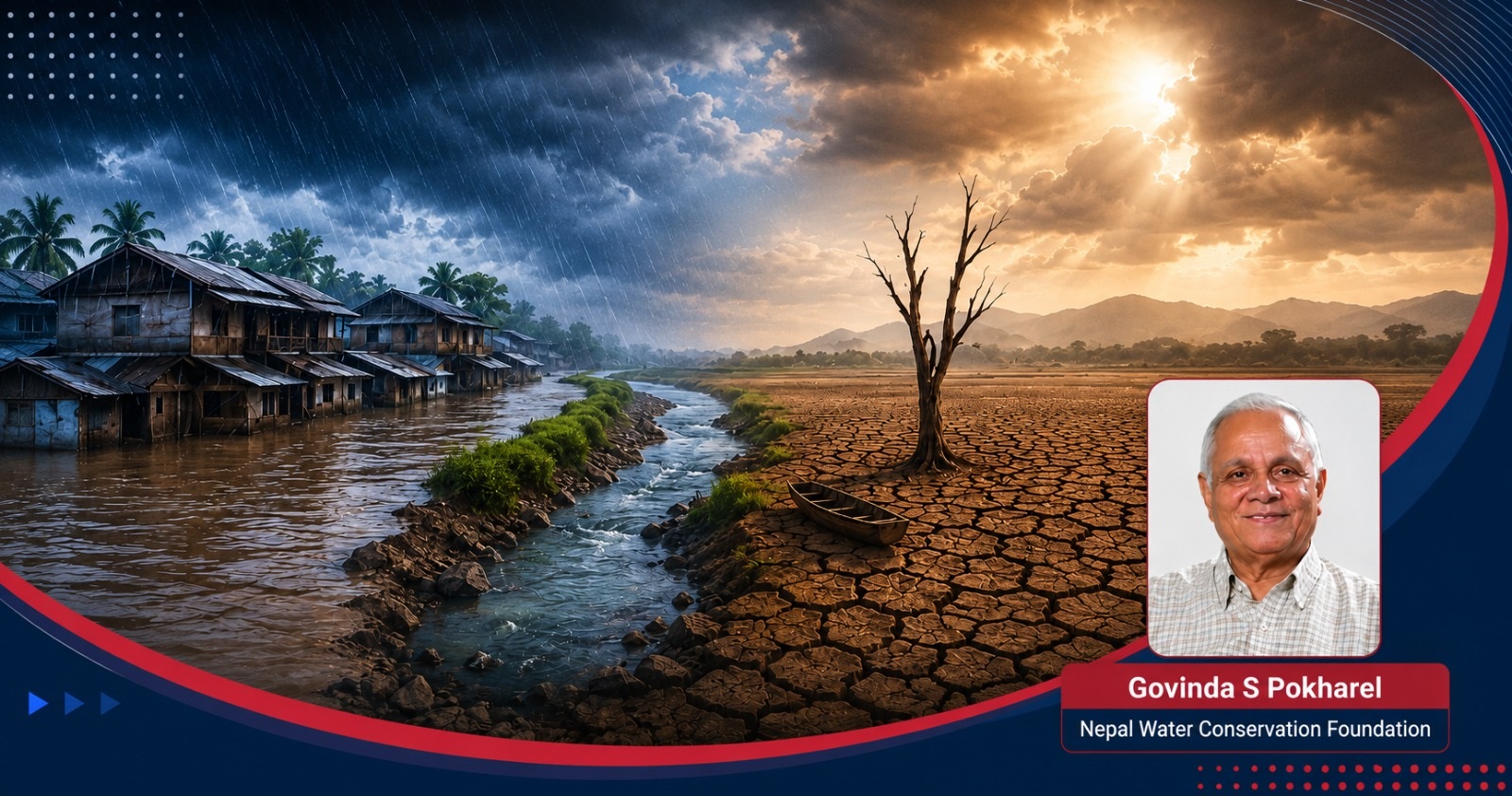
Introduction: Nepal's eastern Terai and India's north Bihar share deep cultural ties expressed in the phrase “Roti Beti Ka Sambandh,” highlighting the relationship from food up to marriage.
Almost every year, these regions experience four months of intense monsoon rainfall resulting in the destructive floods, followed by water scarcity in remaining eight months period. This imbalance has shaped livelihoods, politics, and development for centuries, but solutions remain elusive.

The Monsoon Imbalance: Over 80 percent of Nepal’s annual rainfall occurs during the monsoon, while Bihar receives nearly 88 percent of its precipitation in the same period. This extreme seasonality leaves both regions water-stressed: inundated during the rains and parched afterward. The imbalance is not new. It has existed since settlement began thousands of years ago — the governments of both countries have failed to come up with comprehensive strategy for sustainable management. Instead, floods with high water resource potential are seen as calamities, not resources.
Floods in north Bihar are contributed by three main sources: the floods from Nepal Terai, the floods originating in the Darjeeling Hills and the monsoon precipitation of north Bihar itself. The contribution of monsoon precipitation of north Bihar is estimated 31 billion cubic meters (BCM), which amounts to about 28 percent of the total volume of water flooding north Bihar. The estimated total volume of water required for paddy cultivation in north Bihar calculated for 80 percent of the total area of north Bihar at 1000mm is calculated as 35.2 BCM excluding water logged areas. The two figures presented above show that the monsoon rainfall of north Bihar itself is hardly enough for local paddy cultivation, as only spatial and temporal variation of the monsoon rain can contribute to flooding in north Bihar to some minor extent. It also indicates that some part of the flood water from Nepal is required for Bihar for paddy cultivation in monsoon. The contribution of Nepalese rivers in the floods of north Bihar is estimated at over 84 BCM, which is over 70 percent of the total monsoon water availability of north Bihar. This underscores the urgent need for a strong Indian commitment and cooperation with Nepal in flood water management. But, Nepal-India bilateral agenda hardly covers this aspect.
Colonial Legacies and Blame Game: Flood management in Bihar has long followed a colonial model emphasizing politically motivated embankments rather than holistic solutions. The British dubbed the Kosi River “the sorrow of Bihar,” and independent India has largely continued this mindset. Politicians often blame Nepal for floods, citing its rivers as the source of devastation. As one 1987 India Today article noted, “Each time north Bihar is devastated by floods, the state government performs two rituals. It holds neighboring Nepal responsible and promises to implement a master plan for flood control.” This rhetoric deflects responsibility while perpetuating underdevelopment. This author considers such act as “the new colonial model” followed by the Central Government of India and the local politicians are happy as long as their rents are assured.
Human and Economic Costs: Floods in Bihar have killed nearly 9,500 people between 1979 and 2019, with catastrophic years like 2008 claiming over 2,500 lives alone. Embankments, intended as protective measures, have paradoxically expanded flood-prone areas from 2.5 million hectares in 1954 to nearly 7 million hectares by 2004. Beyond human casualties, floods destroy property worth billions annually, eroding infrastructure, agriculture, and livelihoods. The cycle of poverty in Bihar is directly linked to this recurring devastation. Moreover, the people of north Bihar are forced to live a life of insecurity against the next imminent flood and resulting misery.
The records of high floods show that the largest flood in Kosi amounted to 25,800 cumecs (9.13 lacks cusecs), the same in Gandak amounted to over 20,000 cumecs and the same in Bagmati amounted to 15,300 cumecs. The probability of all the maxima mentioned hereinabove falling at the time frame is very small however its possibility cannot be ruled out. People of north Bihar have recently witnessed the misery caused by a relatively small flood in 2008, in which the highest flow was merely 4,500 cumecs. What will happen if the flood of October 5, 1968 when the highest flood was recorded as 25,800 cumecs repeats in near future? What can happen if all the three highs mentioned hereinabove happen within a single time frame? Such incident can result in catastrophic humanitarian and economic losses with huge damages in the infrastructures across north Bihar.
The Case for High Dams: High dams in Nepal’s hills could regulate considerable part of monsoon flows. Dams on the main rivers of east Nepal can store up to 70 BCM of flood water. Such dams should be designed for flood control, irrigation and food security, navigation and electricity generation on priority basis. Rest of the benefits of damming flood water will come as a byproduct. However, current joint project priorities skew toward electricity generation rather than flood control, give priority to megawatts rather than saving Indian lives. This imbalance reflects India’s policy bias and leaves Nepal with no option. For Nepal, navigation to the sea and equitable food security benefits are the two main priorities which are often sidelined in bilateral negotiations.
Economic Feasibility: The estimated cost of a comprehensive flood control program including dams, canals, dredging, and environmental mitigation are colossal but the benefits are colossal as well. And apart from that the benefits of saving Indian lives cannot be evaluated in terms of economic figures. My estimate of costs and benefits confirm that the total investment on this project can be recovered within a short period of time. The project has been evaluated as a project suitable for private financing with due cooperation from the governments.
Human Security Beyond Economics: Flood control is not merely an economic issue. It is about human dignity and security. As the “Human life is invaluable; therefore, prevention of human deaths due to any mitigable hazard is of prime importance for any civilized society or government.” The inability to build permanent infrastructure in flood-prone areas perpetuates poverty and instability. Effective flood water management would unlock opportunities for industries, tourism, fisheries, and sustainable agriculture.
Toward a New Paradigm: The path forward requires a paradigm shift, from the present paradigm to the following on the basis of priority:
• Flood control as the first priority: Projects must prioritize flood mitigation over hydropower.
• Integrated water management: Combining dams, sediment control, and watershed management and soil conservation for maximizing benefits.
• Meaningful cooperation: Indian media and politicians must move beyond playing the blame game to meaningful cooperation as well as investment priority and to shared responsibility.
• Community resilience: Empowering local populations with adaptive strategies.
Conclusion: The annual floods affecting Nepal and Bihar should no longer be viewed solely as natural disasters. They are the result of institutional weaknesses, fragmented policies and the persistence of outdated approaches. With coordinated planning, shared investment to construct high dams, integrated river basin management and equitable benefit-sharing transform floods from a curse into a resource, breaking the cycle of poverty and opening pathways to prosperity across the region.
The author is affiliated with the Nepal Water Conservation Foundation.
Conversation

More News




- Nepal's First Energy Based News Portal
-
Energy Information Center Pvt. Ltd.
Hemant Marg-11, Babar Mahal, Kathmandu
- Info. Dept. Reg. No. : 254/073/74
- Telephone : +977-1-5321303
- Email : [email protected]