Energy Update



ERC Revamps Electricity Tariff Rules, Introduces Annual Review Condition
-
 Urja Khabar
- 7 August, 2026
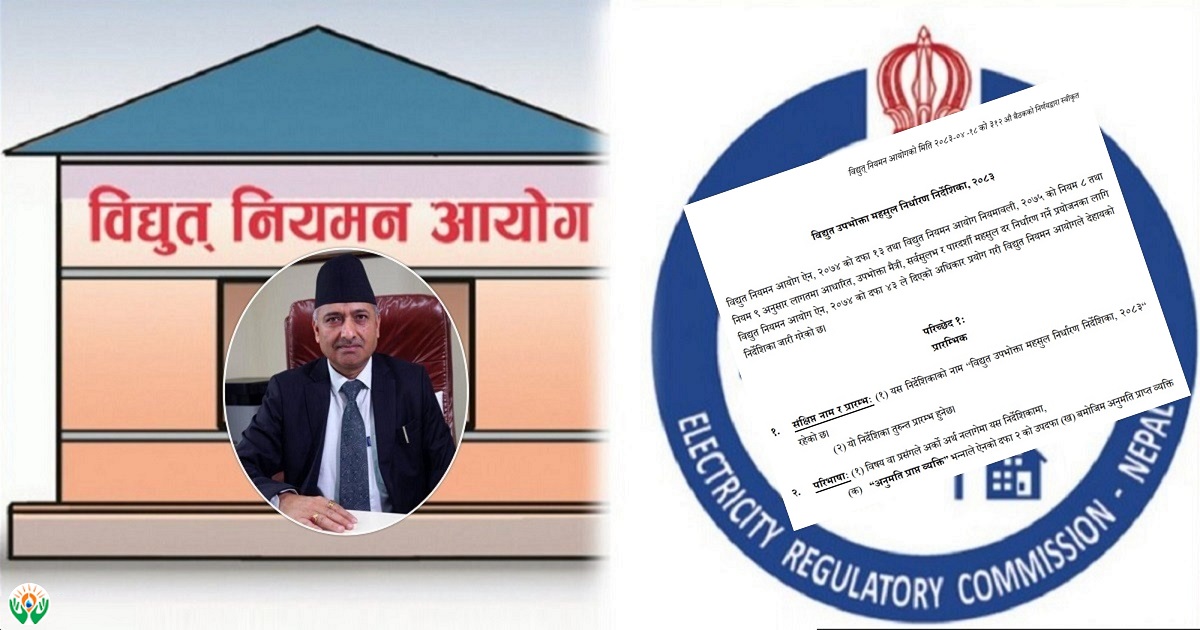
KATHMANDU; The Electricity Regulatory Commission (ERC) has introduced new guidelines for determining electricity consumer tariffs, paving the way for a more systematic and regular review of electricity rates.
The commission has issued the ‘Electricity Consumer Tariff Determination Guidelines, 2083’, replacing the previous tariff determination guidelines. The new guidelines were endorsed by the commission on August 3 in accordance with Section 43 of the Electricity Regulatory Commission Act, 2017.

According to the ERC, the new guidelines aim to establish a cost-based, consumer-friendly, accessible and transparent system for determining electricity tariffs. They seek to make the tariff-setting process more systematic in line with Section 13 of the Act and Rules 8 and 9 of the Electricity Regulatory Commission Regulations, 2018.
The guidelines set out the principles that distribution licensees, including Nepal Electricity Authority (NEA) and Butwal Power Company, must follow while proposing electricity tariffs. They also specify the components of annual required revenue, the methodology for calculating such revenue and the overall procedure for tariff determination.
Annual Tariff Review Introduced
A key provision of the new guidelines is the annual review of electricity tariffs. Distribution licensees are required to submit tariff applications within three years of the implementation of the existing tariff. While submitting an application, licensees may seek either a one-year or multi-year tariff determination.
The ERC will review the tariff annually based on the actual financial and operational situation. The guidelines also provide for calculating the difference between the actual revenue collected during the tariff implementation period and the estimated required revenue. Any surplus or shortfall can subsequently be adjusted while determining future tariffs.
Government Policies to Influence Tariff Decisions
Under the new framework, the ERC will consider the policies and priorities of the Government of Nepal as an important basis for electricity tariff determination.
These include the Energy Consumption Growth and Export Strategy, 2026, the government's Policies and Programmes for fiscal year 2026/27, the 100-point governance reform agenda and policy directions issued by the Ministry of Energy, Water Resources and Irrigation.
The commission has also emphasized policies aimed at increasing electricity consumption, promoting electricity-intensive industries and new enterprises, improving energy efficiency and advancing sustainable development goals.
Similarly, priority will be given to the production and use of green energy, while electricity consumption based on the time of day (TOD) will also be encouraged.
Long-run Marginal Cost to Guide Future Tariffs
The ERC has stated that the long-run marginal cost of electricity generation will be gradually incorporated into tariff determination.
The approach will be applied progressively based on factors including consumer category, time period, season and voltage level.
The new framework is expected to make electricity tariff determination more predictable and transparent while allowing tariffs to respond more systematically to changes in costs, consumption patterns, government policy and the overall electricity market.
Conversation


More News



- Nepal's First Energy Based News Portal
-
Energy Information Center Pvt. Ltd.
Hemant Marg-11, Babar Mahal, Kathmandu
- Info. Dept. Reg. No. : 254/073/74
- Telephone : +977-1-5321303
- Email : [email protected]