Energy Update



Global Shocks, Local Solutions: Nepal’s Energy Security Choices
-
 Er. Amnaya Paudel / Er. Bidur Bhusal
- 8 April, 2026
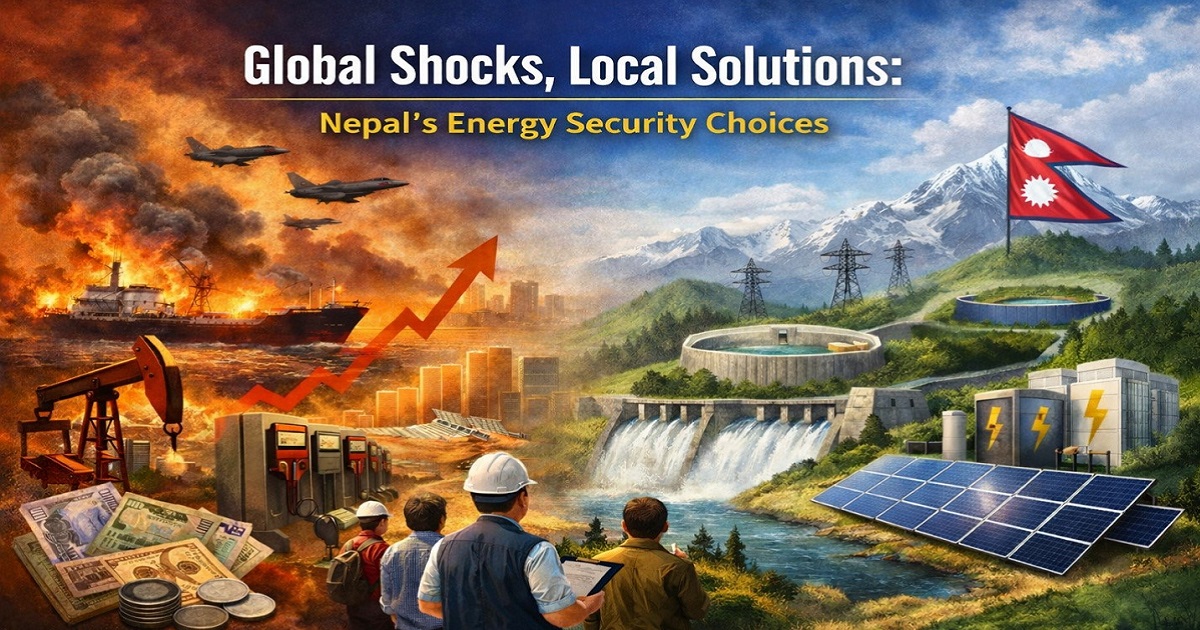
Energy security is often discussed as a quick choice where one option is selected and the discussion moves on. Storage hydropower, pumped storage and solar with battery storage are often presented as competing answers, but Nepal’s power system is not that simple. Different problems appear at different times of the day and in different seasons, so no single option can solve everything. The key issue is sequencing, which means deciding what can be implemented quickly to reduce pressure now and what projects must be started early because they take years to deliver.
A recent LinkedIn poll on Nepal’s energy priorities offered a useful signal. Storage hydropower received the highest support at 52 percent, followed by pumped storage hydropower at 25 percent, while solar with battery energy storage systems received 23 percent. The poll reflects public thinking, but the practical task is to match solutions to specific system needs and realistic timelines.

Two Different System Problems Are Being Combined in One Debate
Nepal’s energy security debate often mixes two separate problems, even though they occur on different time scales and require different responses. The first is the dry season problem. Run of river plants produce much less when river flow is low and imports become more important for several months. This affects national planning, increases costs and raises exposure to external supply and price shocks.
 The second is the evening peak problem. Demand rises sharply within a short time window, and the system needs resources that can respond quickly and reliably. This is the period when many consumers feel shortages or operational stress most clearly and it is also when system operators need flexibility, not only total energy.
These two problems are different, so they should not be treated as one combined choice. The debate becomes clearer when needs are separated first and solutions are compared after.
Storage Hydropower
Storage hydropower is important because it can support the system during the dry season when river flows are low and run of river generation drops. It can also provide controllable power during peak hours, which is valuable in a system where most generations are run-of-river and flexibility is limited. It is one of the few options that can provide firm supply over longer periods, not only for short peaks.
At the same time, storage hydropower is difficult to deliver. These projects require large civil work and long construction timelines, so they are capital intensive and time intensive. They also carry higher development risks, including geological uncertainty, seismic concerns and environmental and social issues that can take years to resolve. Land acquisition and resettlement can become sensitive, and cost and schedule overruns are common in practice.
Even when storage hydropower is critical for energy security, it is not always feasible for private investors to finance and deliver such projects on a standalone basis.
This creates a practical gap between what the country needs and what private developers can carry on their own. Even when storage hydropower is critical for energy security, it is not always feasible for private investors to finance and deliver such projects on a standalone basis. Public leadership is therefore necessary to make storage projects viable through strong early studies, clear and stable rules, predictable approvals and transparent risk sharing. In some cases, well-designed support may also be needed to improve bankability while keeping accountability and performance discipline intact.
Pumped Storage
Pumped storage hydropower addresses a different system need than conventional storage hydropower. Its main role is to shift electricity across time. It uses electricity during low demand hours to pump water to an upper reservoir and then generates during peak hours, so that electricity is available when the system value is higher.
This flexibility becomes more important as the grid changes. Demand growth increases the size of the evening peak and raises the need for resources that can respond quickly. Solar growth adds another challenge because solar output is variable and can dip suddenly when clouds or rain pass through. When that happens, the grid must quickly replace the lost injection to keep supply and demand balanced. This creates a ramping requirement. Ramp means the required rate of change in net injection into the grid over a short time and it is often met by increasing or decreasing generator output. Sudden imbalances also show up as frequency changes, so fast response resources become especially valuable.
pumped storage can deliver its full value only when enabling conditions are in place. It needs surplus or low-cost electricity for pumping, dispatch rules that actively use flexibility and a clear way to pay for the services it provides beyond energy alone.
However, pumped storage can deliver its full value only when enabling conditions are in place. It needs surplus or low-cost electricity for pumping, dispatch rules that actively use flexibility and a clear way to pay for the services it provides beyond energy alone. Network readiness is also critical. Pumped storage behaves as a large controllable load while pumping and as a generator while producing, so transmission and substation capacity must support reliable withdrawal and injection in both directions. If these conditions are weak, pumped storage may exist on paper but remain constrained in operation and weak in economics. The implication is not to avoid pumped storage, but to plan system rules, network capacity and remuneration so that its flexibility can be used and valued properly.
Solar and BESS
Solar and battery systems draw attention for practical reasons. They can be delivered faster than large hydropower projects and they can be expanded in smaller phases. This makes them useful when near term pressure is high and the system needs visible improvement without waiting for long construction cycles.
Battery energy storage systems can directly support the evening peak and short-term operational needs. They respond quickly, can be located close to demand or at stressed network points and can improve reliability in specific areas when they are properly sized, controlled and integrated into dispatch and protection arrangements. These are important advantages in a system where insecurity is often felt most during a narrow evening window.
At the same time, batteries should not be presented as a complete solution for the dry season challenge. Providing energy for a few hours is a different problem from covering an energy gap that lasts for months. At current technology and cost levels, batteries are generally not the lowest cost option for bridging a multi month dry season deficit at national scale. Their strongest role is therefore complementary, reducing stress now while longer duration assets move through planning, approvals and construction.
The First Priority Should Be a System Plan That Makes Sequencing Explicit
Nepal’s first priority should not be to choose a single technology. It should be to adopt a clear system plan that links specific needs to specific solutions and then implements them in a deliberate sequence.
Such a plan should separate needs clearly and convert them into procurement and operational requirements. Dry season firmness requires long duration supply. Evening peak stress requires resources that can respond quickly and reliably. Grid stability requires fast response and clear operating rules. When needs are defined in this way, procurement becomes more disciplined and contracts can be structured around the service that is required, not only installed megawatts.
A phased approach then becomes practical. Some measures can be delivered quickly and show results within short time frames. Other projects take years and must be started early if they are to be available when the system depends on them. Clear milestones, clear risk allocation and clear payment mechanisms reduce uncertainty and reduce the chance of investing heavily in a solution that does not match the duration of the problem.
Nepal does not need to declare one winner. It needs to match solutions to system needs and apply them in a clear sequence. Storage hydropower remains the strongest long-term option for dry season firmness, but it requires early action because it is complex and time intensive.
Energy Security Also Means Resilience
Cross border trade is useful and should continue. It can reduce costs and help balance the system, especially when Nepal faces seasonal deficits. However, dependence in the dry season also creates exposure because shocks outside Nepal can arrive quickly through prices, supply constraints and wider economic pressure. That is why domestic resilience matters alongside trade.
A balanced portfolio reduces this exposure. When Nepal can meet more of its dry season needs domestically and manage short term stress through flexible resources, the system becomes more stable and planning becomes easier.
The Geopolitical Moment Makes the Case Harder to Ignore
The case for domestic energy resilience is not theoretical. Recent geopolitical tensions and conflict risks around major fuel supply routes have shown how quickly global energy markets can tighten and how sharply prices can move. These shocks spread through shipping costs, risk premiums and supply uncertainty and import dependent economies feel the impact first.
Nepal experiences this through higher household costs, higher transport and industrial expenses, inflation pressure and fiscal strain when the state tries to cushion consumers. Foreign exchange pressure and wider trade balance impacts also become harder to manage during periods of global volatility.
In that context, domestic clean energy and storage are not only technical choices for grid planning. They also reduce exposure to fuel price shocks and external disruptions that Nepal cannot control. The more uncertain the external environment becomes, the stronger the case for early action and committed investment in domestic resilience.
Conclusion
Nepal does not need to declare one winner. It needs to match solutions to system needs and apply them in a clear sequence. Storage hydropower remains the strongest long-term option for dry season firmness, but it requires early action because it is complex and time intensive. Pumped storage is a strong option for daily flexibility and peak support, but it delivers value only when dispatch rules, transmission capacity and remuneration are designed to use it properly. Solar and BESS can move faster and provide near-term relief, especially for evening peak stress and local reliability, but they should be positioned as complementary rather than a full dry season solution.
The more sensible path is to use all three options with a clear plan that is based on system needs, realistic timelines and domestic resilience, so that near term pressures are reduced while long duration assets are prepared for the years ahead.
Disclaimer: The opinions expressed herein are purely personal and are not intended to represent the position, policies, or perspectives of any organization, institution, or professional affiliation of the author.
Conversation
Er. Amnaya Paudel / Er. Bidur Bhusal

More News



- Nepal's First Energy Based News Portal
-
Energy Information Center Pvt. Ltd.
Hemant Marg-11, Babar Mahal, Kathmandu
- Info. Dept. Reg. No. : 254/073/74
- Telephone : +977-1-5321303
- Email : [email protected]